A confirmed transaction does not always mean every payment inside it succeeded. In reporting dated November 17, 2026, simulations of Juicebox payment contracts on the Sepolia testnet showed a compatibility risk associated with Ethereum’s proposed Glamsterdam upgrade. These were test results, not a report of confirmed mainnet losses.
According to Juicebox’s technical documentation, an NFT purchase test left the buyer with the NFT even though an internal payment to a related project ran out of gas; the unpaid funds remained in the paying project. In a token-distribution test, a cross-project payment failed while the reserved-token allocation completed, leaving the beneficiary with the project’s original token rather than the intended cross-project settlement. A redemption test found that, within a reported range of 679,622 to 817,622 gas, redemption could complete while the internal 2.5% protocol-fee payment failed.
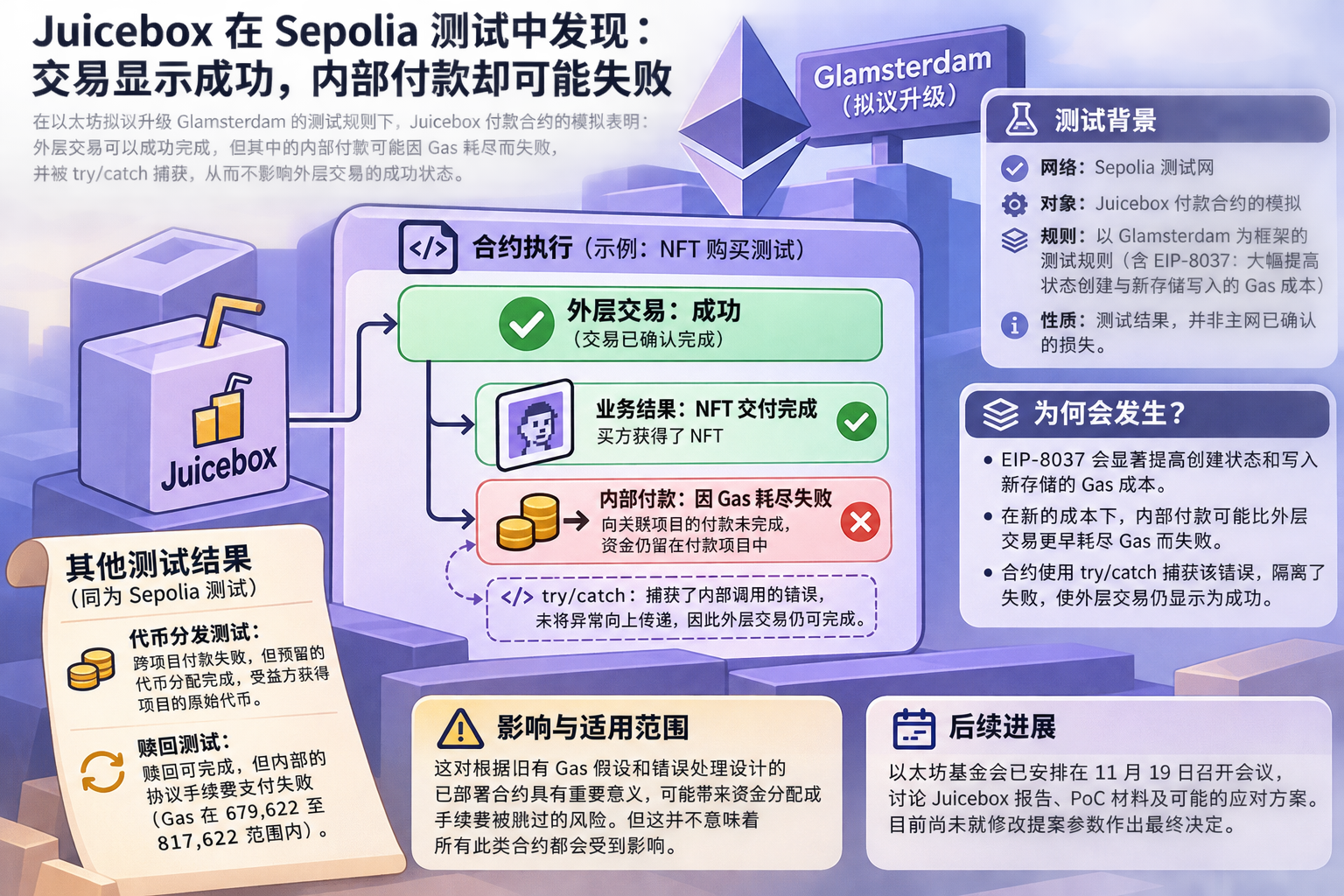
Juicebox developer mejango linked the behavior to proposed changes in gas costs and the contracts’ error handling. Under the tested rules, EIP-8037 would substantially increase the cost of creating state and writing to new storage. An internal payment could then run out of gas before the outer transaction did. If a contract catches that error with try/catch, the outer transaction can still complete. The developers reported that comparable mainnet simulations in the same gas range either failed entirely or completed the payment; they did not show an internally skipped payment.
The finding matters for previously deployed contracts whose gas assumptions and error handling were designed under older rules. It does not establish that every such contract is affected. The November 17 report said the Ethereum Foundation had scheduled a November 19 meeting to discuss the Juicebox report, proof-of-concept materials and possible responses, with no final decision yet on changing proposal parameters. For anyone assessing a contract’s payment behavior, the test illustrates why an outer transaction’s success status alone may not establish that its intended internal transfers occurred.