For anyone trading on a new chain, the security question is not only who holds the wallet keys. It is also whether other participants can get a faster route for submitting transactions. When PANews reported on Elysium on November 9, 2026, its mainnet was scheduled to launch later that evening, and that question was already the subject of a community dispute.
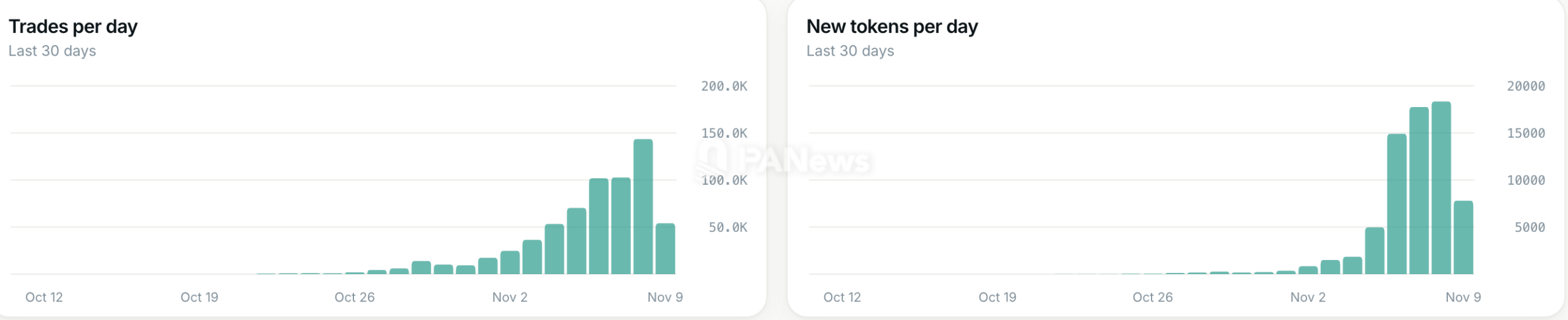
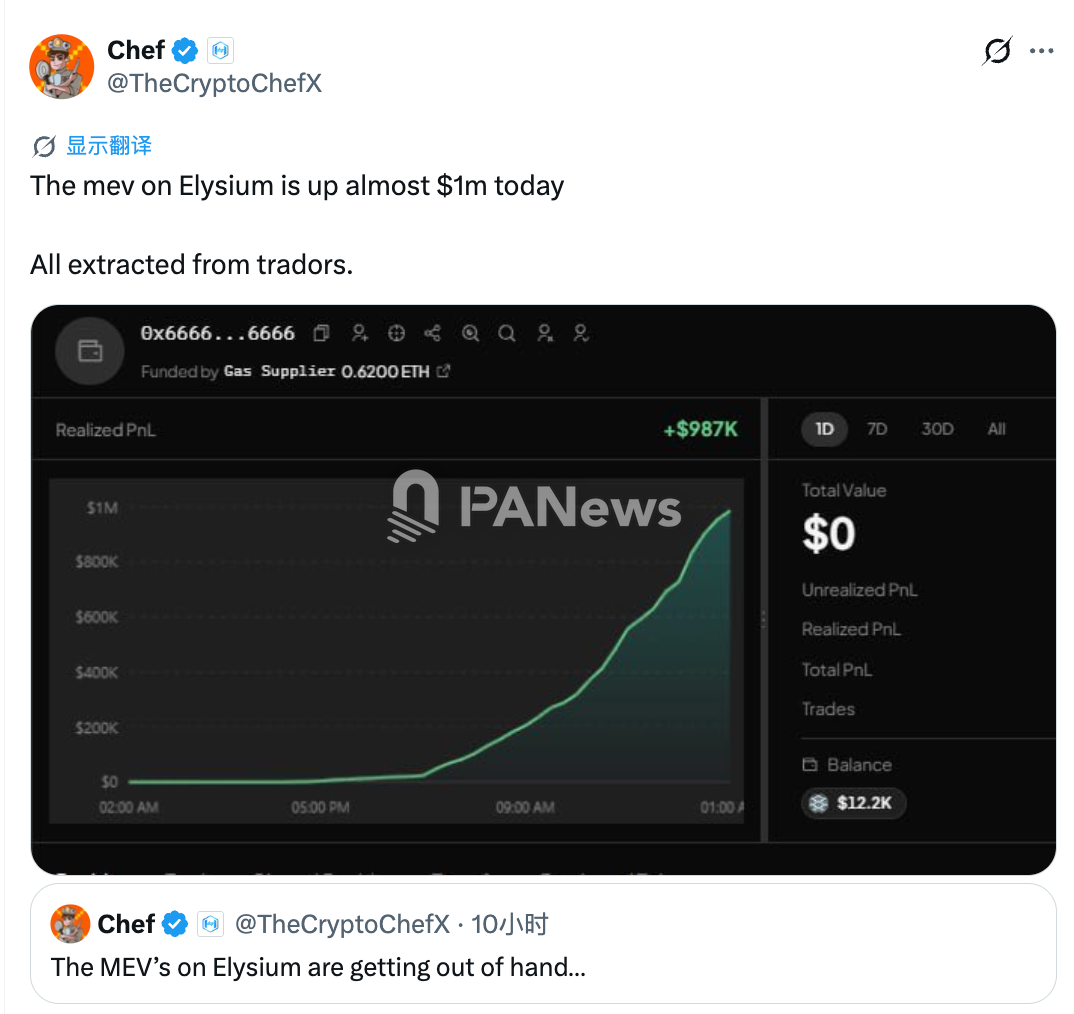
Community members alleged that a particular wallet used private-node access and special permissions to run an MEV bot that repeatedly sandwiched Launchpad trades. PANews said the address had been publicly labeled a high-frequency sandwich-attack bot and that on-chain records showed profits approaching $1 million. Those claims do not, by themselves, establish how the address obtained access.
According to PANews, the Elysium team initially acknowledged a related problem and said it had revoked the address’s RPC permissions. After community members reported further suspected MEV activity, the team said the transactions had instead used the normal HyperEVM Delayed Inbox route and denied any abuse of sequencer permissions.
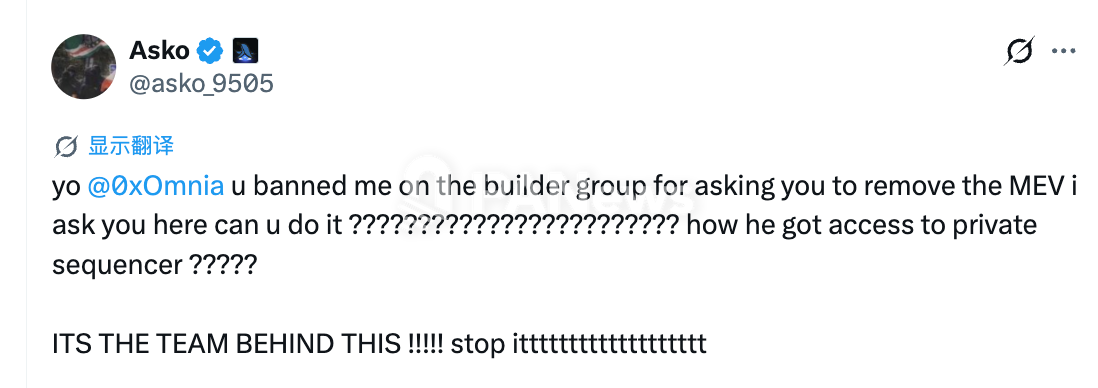
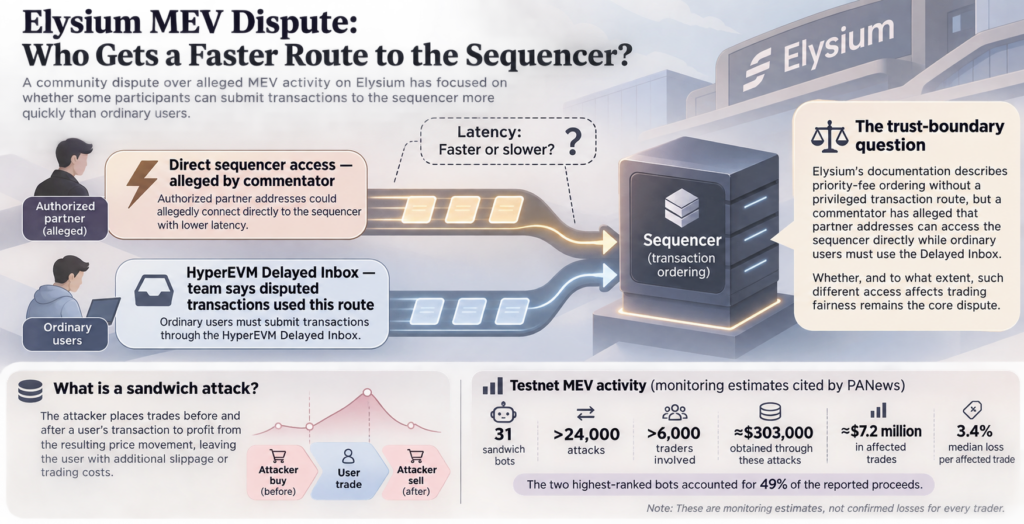
Crypto commentator @y_cryptoanalyst offered a competing account: although Elysium’s documentation described priority-fee ordering without a privileged transaction route, authorized partner addresses could allegedly connect directly to the sequencer with lower latency, while ordinary users had to use the Delayed Inbox. That alleged difference in access—not proof that every affected trade used a privileged route—is the unresolved trust-boundary question.

The potential cost to traders was substantial in the monitoring data cited by PANews. As of its report, femtos.xyz had observed 31 sandwich bots carrying out more than 24,000 attacks involving more than 6,000 traders over the preceding seven days on Elysium’s testnet. It estimated about $303,000 obtained through those attacks across roughly $7.2 million in affected trades, with a median loss of 3.4% per affected trade. The two highest-ranked bots accounted for 49% of the reported proceeds. These are monitoring estimates, not confirmed losses for every trader.
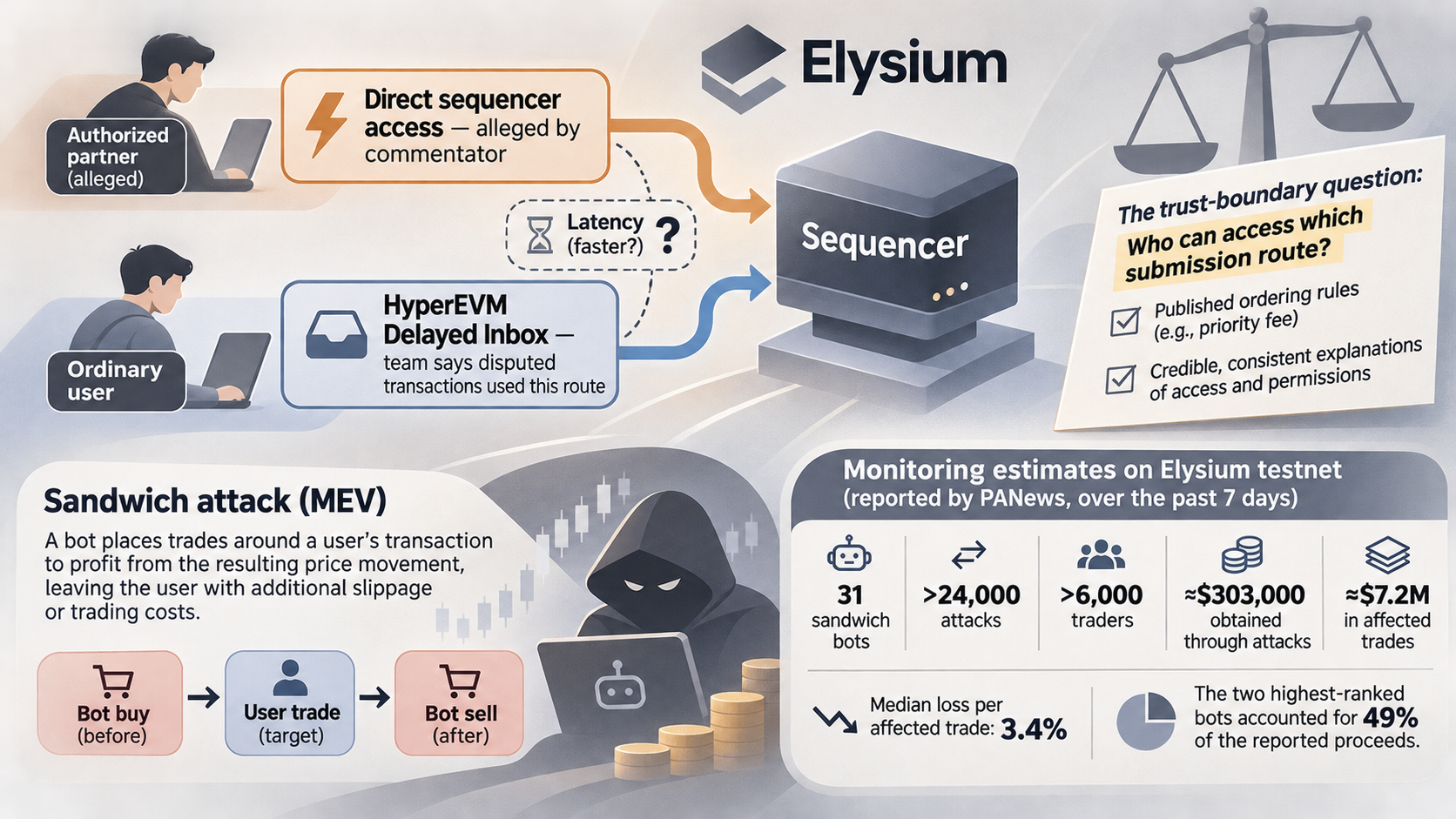
A sandwich attack places trades around a user’s transaction to profit from the resulting price movement, leaving the user with additional slippage or trading costs. Elysium’s dispute illustrates a practical limit of wallet hygiene: protecting keys cannot prevent unfavorable execution. For users assessing a trading venue, published ordering rules and credible explanations of who can access each submission route matter alongside custody practices.