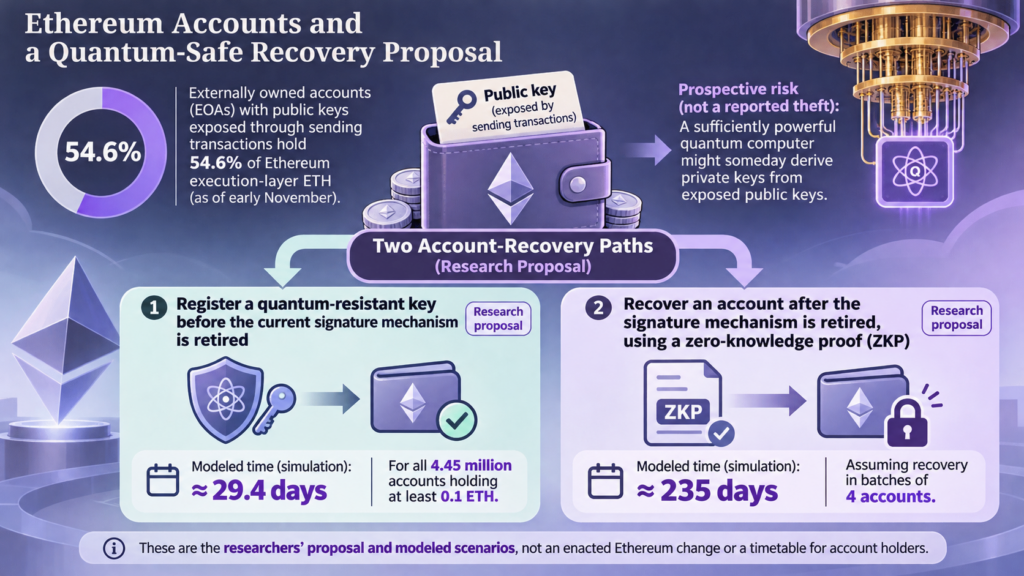
If you have sent a transaction from an Ethereum account, its public key may be exposed. Researchers from the University of Pittsburgh and SeQure said in a paper reported on November 24, 2026, that externally owned accounts with public keys exposed through sending transactions held 54.6% of Ethereum execution-layer ETH as of early November.
The concern is prospective, not a reported theft: the researchers said a sufficiently powerful quantum computer might someday derive private keys from exposed public keys. They proposed registering quantum-resistant keys before the current signature mechanism is retired, then using zero-knowledge proofs to recover accounts afterward. This is a proposal, not an enacted Ethereum change.
In a simulation based on mainnet data, the researchers estimated that advance registration of all 4.45 million accounts holding at least 0.1 ETH would take about 29.4 days. If all instead needed recovery after retirement, at four accounts per batch, they estimated about 235 days. Those figures describe the modeled scenarios, not a timetable for account holders.