For anyone considering Raycash as a place to hold or spend stablecoins, the key questions are who controls the wallet and who can see its activity. As reported on November 9, 2026, at 17:07 UTC+8, Foresight News, citing The Block, said the Zama spinout had launched on Ethereum mainnet but remained in private testing. Raycash said more than 75,000 people had joined its waitlist; access would open in batches before a wider release.
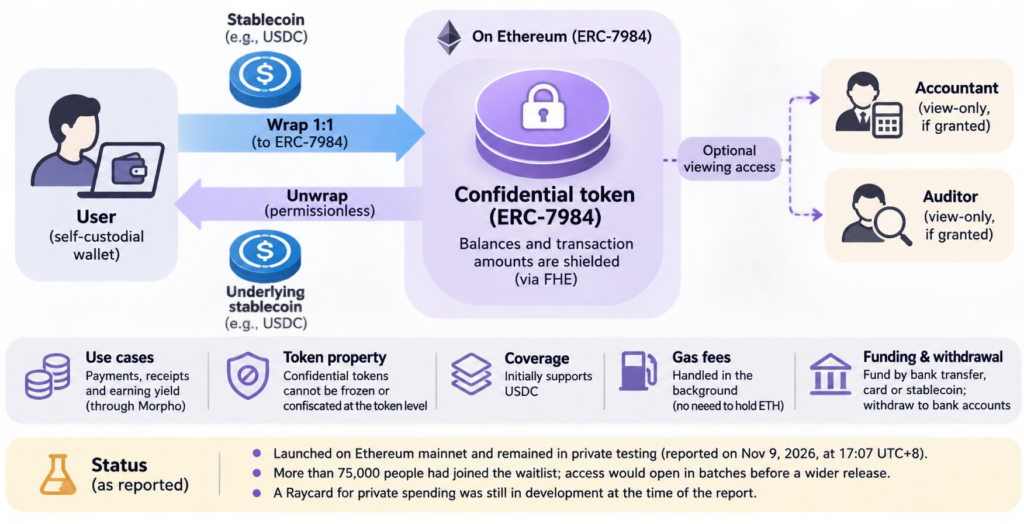
Raycash says its wallet is self-custodial. Built on Zama’s protocol, it uses fully homomorphic encryption to keep on-chain balances and transaction amounts private. Users can wrap stablecoins 1:1 into tokens under the ERC-7984 confidential-token standard for payments, receipts and earning yield through Morpho. The underlying stablecoins can be recovered through permissionless unwrapping.
Raycash also says confidential tokens cannot be frozen or confiscated at the token level, and users can grant selected parties, such as accountants or auditors, viewing access. Those are specific claims about the token and disclosure controls—not a claim that every aspect of using the service is private.
Initially, the application supports USDC. It accepts funding by bank transfer, card or stablecoin and offers withdrawals to bank accounts. Raycash handles Ethereum gas fees in the background, so users do not need to hold ETH. A Raycard for private spending was still in development at the time of the report.
Source: foresightnews.pro (originally published 2026-11-09 17:07 UTC+8)