
For anyone holding assets in Aave lending pools, the security change in V3.8 is a new guard around certain callback operations—not a guarantee that every integration risk has disappeared. As reported on November 12, 2026, Aave V3.8, developed by Aave Labs and approved by Aave DAO, had gone live across 15 Aave V3 markets.
The upgrade uses EIP-1153 transient storage to track a reentrancy lock that clears at the end of a transaction. According to the report, its TSTORE and TLOAD operations each cost 100 gas. The design is intended to avoid the higher cost of maintaining a persistent lock while protecting pool operations that make external callbacks.
The lock is deliberately asymmetric. Aave Labs said flashLoan and flashLoanSimple check the lock without setting it. That allows a flash-loan callback to combine operations such as liquidations, deposits or repayments. A flash-loan request made from inside a callback of a regular pool operation, however, is blocked and reverted.
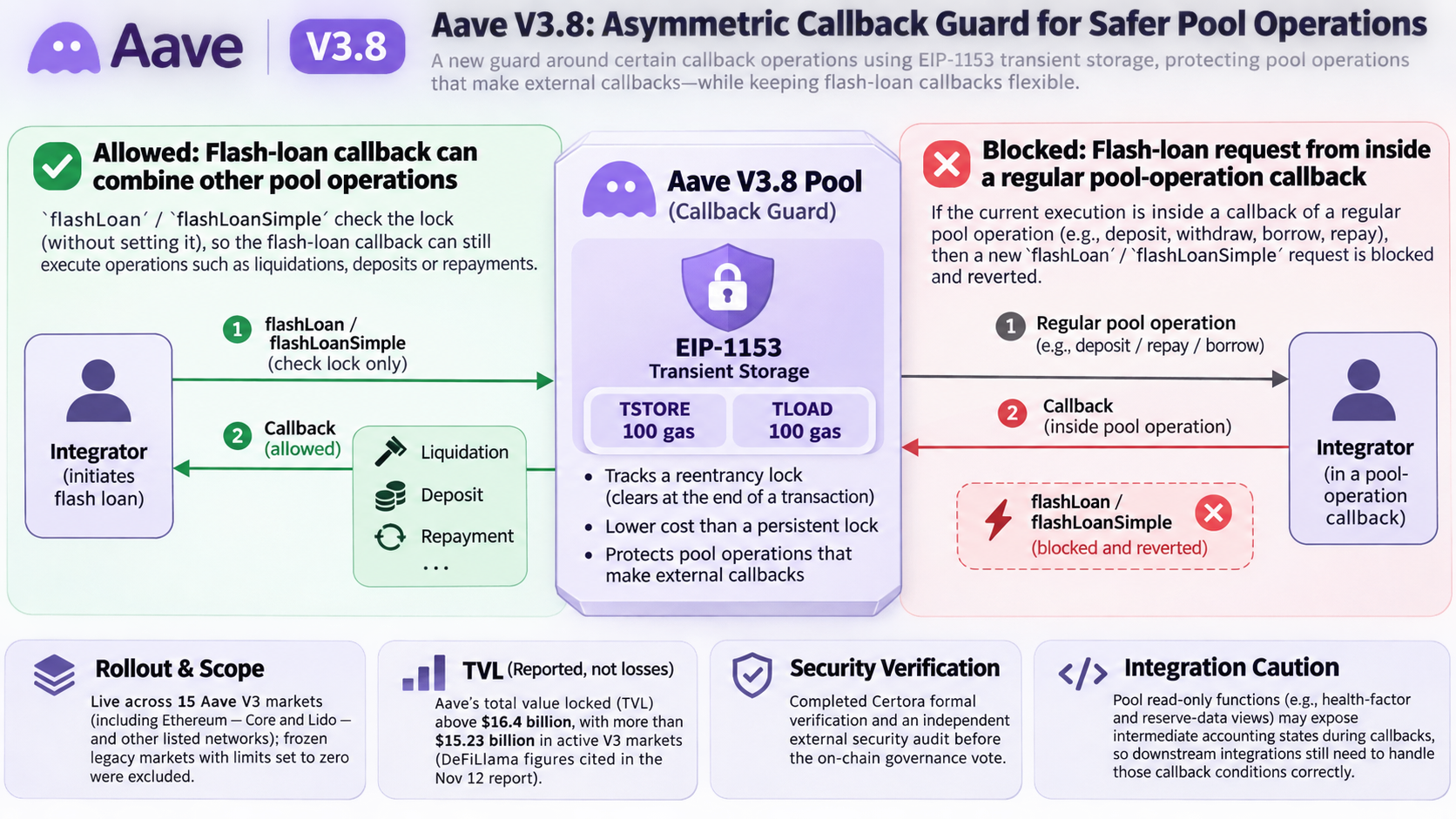
The rollout covers active instances on Ethereum—including Core and Lido—and other listed networks; frozen legacy markets with limits set to zero were excluded. DeFiLlama figures cited in the November 12 report put Aave’s total value locked above $16.4 billion, with more than $15.23 billion in active V3 markets. These are reported TVL figures, not losses or funds recovered.
Before the on-chain governance vote, V3.8 underwent Certora formal verification and an independent external security audit, according to the report. Community developers also cautioned downstream integrators that pool read-only functions, including health-factor and reserve-data views, may expose intermediate accounting states during callbacks. For users, the practical distinction is that a pool-level reentrancy guard does not remove the need for integrations to handle those callback conditions correctly.