If you hold assets in an Ethereum wallet, the practical question is not whether to move them today. It is how you would retain control of the account if its signing method eventually had to change. In an analysis published on November 18, 2026, imToken described that migration as a longer-term challenge for wallets and the Ethereum network. It said no quantum computer capable of breaking the cryptography at issue had emerged, and users did not need to move assets in a panic.
Why account history matters
Ordinary Ethereum accounts use ECDSA signatures to authorize transactions. A sufficiently capable fault-tolerant quantum computer running Shor’s algorithm could, in theory, derive a private key from an exposed public key and forge signatures. That would threaten not only user accounts but also keys used by validators and other systems that rely on related elliptic-curve cryptography.
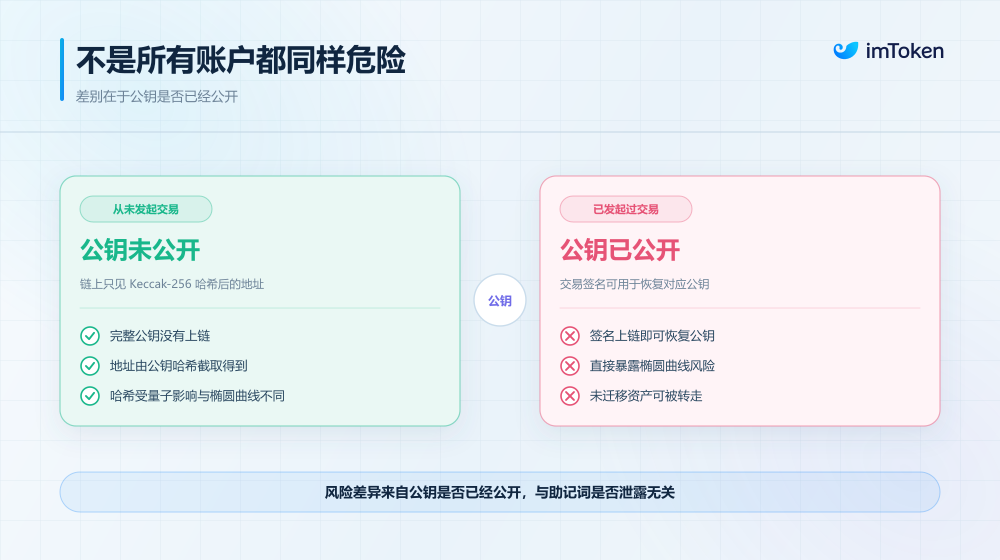
Exposure differs between accounts. An ordinary Ethereum address is derived by hashing a public key. According to imToken, an account that has never sent an on-chain transaction or disclosed an off-chain signature has not exposed its full public key in those ways. Once the account signs a transaction, its public key can be recovered from the public signature. This distinction does not mean an unused account is free of every risk; it explains why public-key exposure matters to this particular hypothetical attack.
Hash functions such as Keccak-256 are more resilient to the quantum attack described here than elliptic-curve signatures. Grover’s algorithm offers a different, square-root speedup; it does not have the same effect as Shor’s algorithm on the elliptic-curve problem.
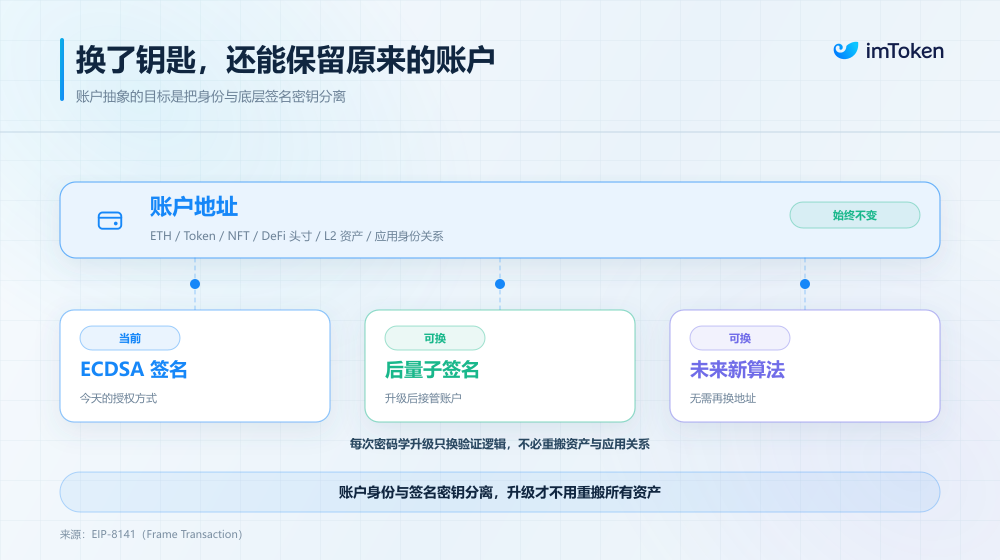
What Ethereum is working toward
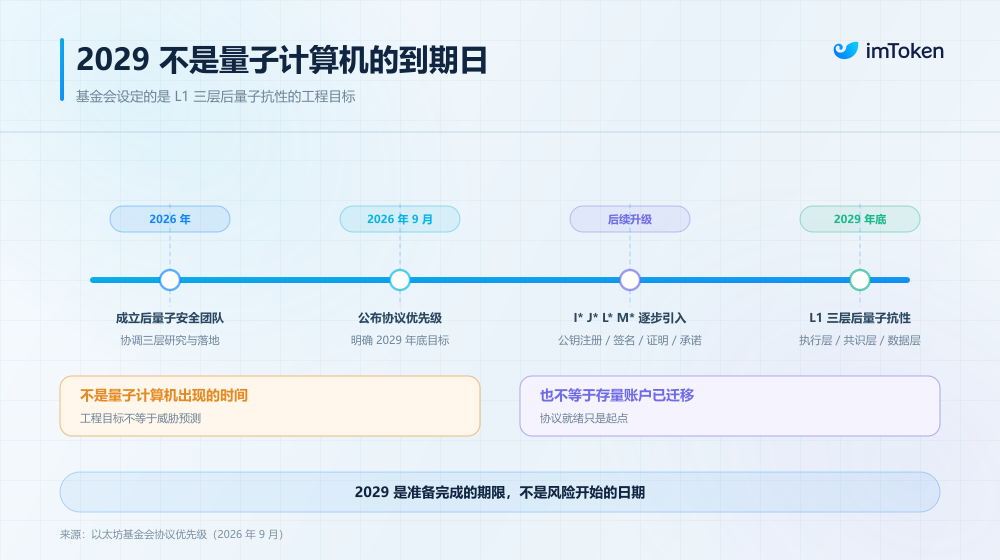
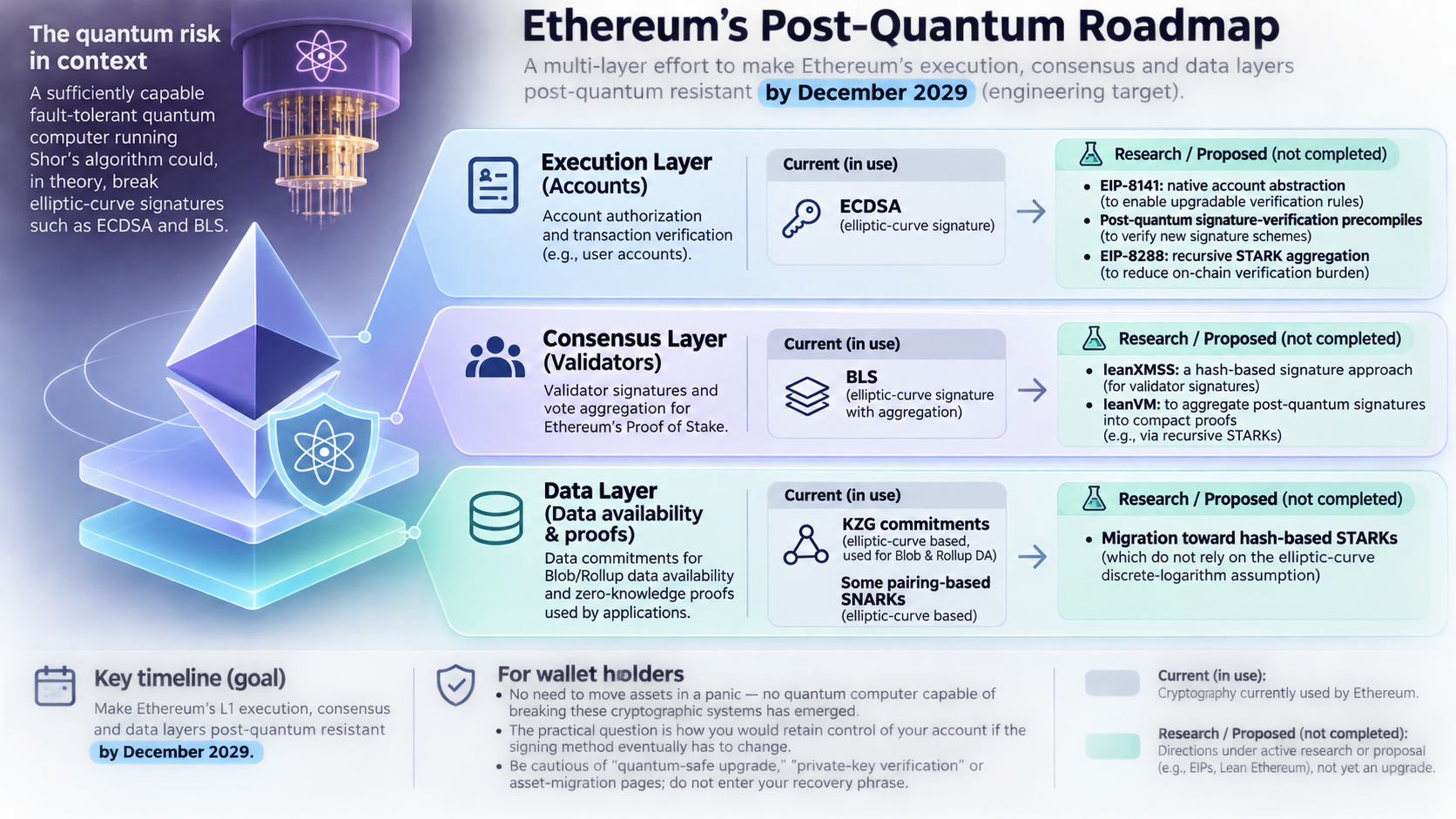
ImToken reported that the Ethereum Foundation formed a Post-Quantum Security team in 2026. It also described a goal set out in September 2026 protocol priorities: making Ethereum’s L1 execution, consensus and data layers post-quantum resistant by December 2029. That is an engineering target, not a completed upgrade or a rule requiring wallet holders to migrate now.
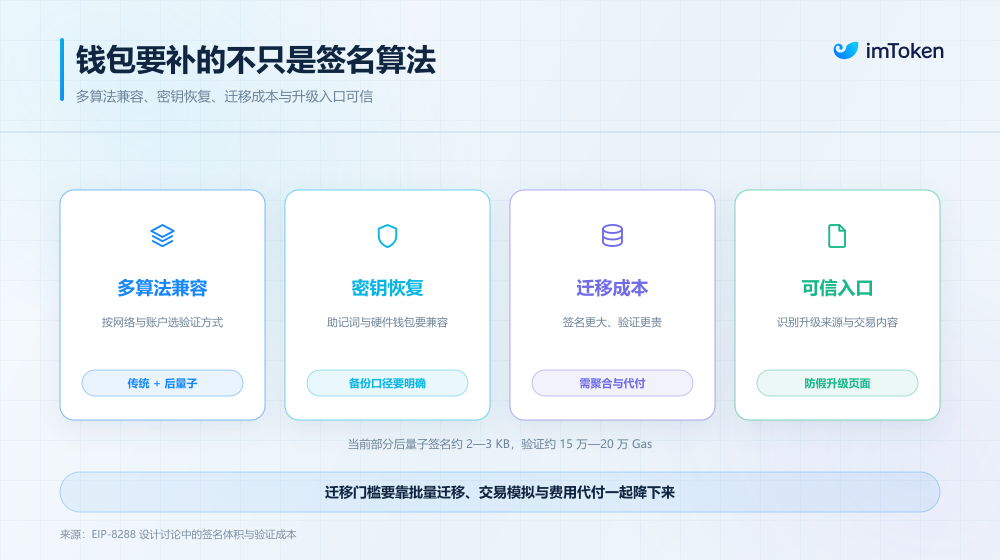
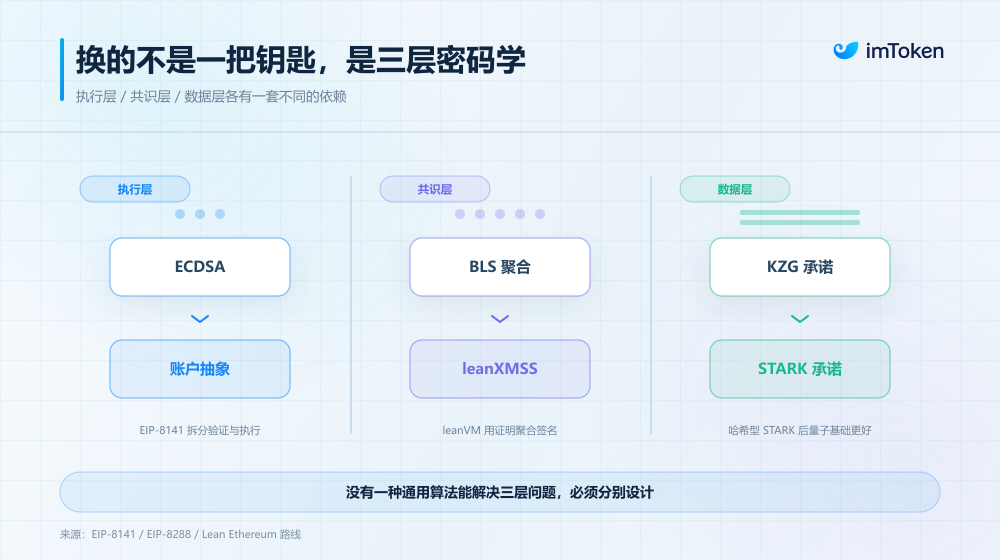
Each layer poses a different problem:
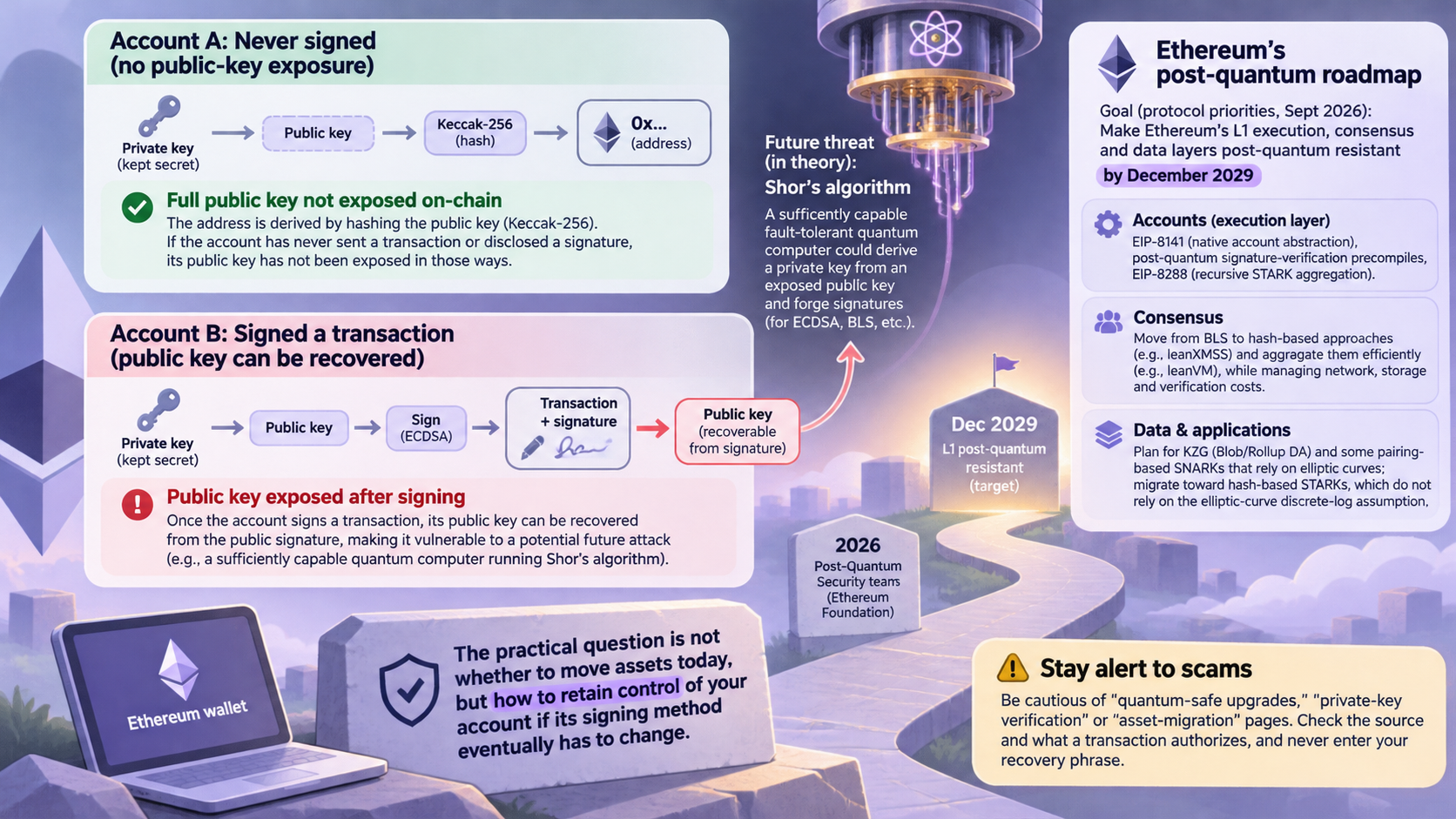
- Accounts: EIP-8141 is a proposal for native account abstraction that could help separate account authorization from one fixed ECDSA key. The aim is to make changes to verification rules—including future signature schemes—possible without necessarily abandoning an account’s existing identity. Work on post-quantum signature-verification precompiles addresses another part of that task. EIP-8288 proposes using recursive STARK aggregation to reduce the on-chain burden of verifying larger post-quantum signatures.
- Consensus: Ethereum currently uses BLS signatures to aggregate validator votes. ImToken described leanXMSS, a hash-based signature approach, and leanVM, intended to help aggregate post-quantum signatures into compact proofs, as directions under the Lean Ethereum roadmap. Replacing BLS must also account for network, storage and verification costs.
- Data and applications: KZG commitments used for Blob and Rollup data availability rely on elliptic-curve-related assumptions. Some pairing-based SNARKs used by applications have similar long-term exposure. Hash-based STARKs do not rely on the elliptic-curve discrete-logarithm assumption, so migration planning extends beyond account signatures and L1.
The wallet migration problem
Generating a new key is only part of an upgrade. An Ethereum address can be tied to tokens, NFTs, DeFi positions, assets on L2 networks and application-specific permissions or history. Moving to a new address could therefore involve more than transferring a balance. Account abstraction could, in principle, let an account change its underlying authorization method while retaining its address, but the capabilities discussed above remain proposals and development work.
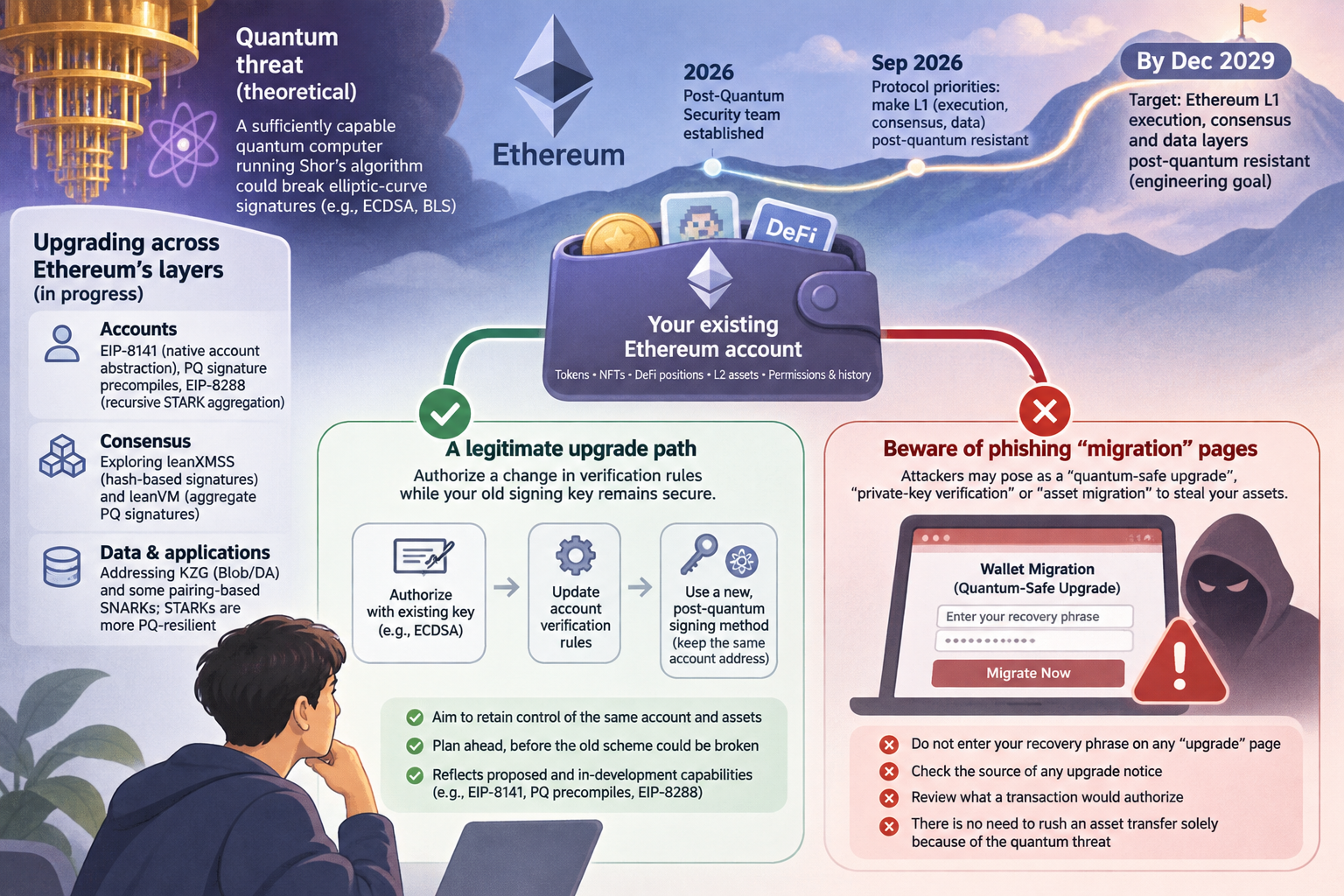
Timing matters. ImToken described an ideal migration as one authorized by the existing key while that signing system remains secure. If an attacker could already forge signatures from the old public key, an old-key signature alone would no longer reliably distinguish the owner from the attacker. Accounts whose keys are lost, whose owners are unaware of an upgrade or that have remained inactive present a further unresolved problem. Whether any such accounts should eventually be frozen is, as the source notes, disputed—not an enacted policy.
For holders, the manageable habit is to treat any supposed “quantum-safe upgrade,” “private-key verification” or asset-migration page with care. ImToken warned that such claims could be used to solicit recovery phrases or malicious approvals. Check where an upgrade notice comes from and what a proposed transaction would authorize; do not enter a recovery phrase into a page claiming to verify or migrate a wallet. There is no source-supported reason to rush an asset transfer solely because of the quantum threat described here.