
If you hold ETH or use a wallet to trade on Ethereum, a key question is who can see and reorder transactions before they settle. A court case involving roughly $25 million in alleged losses shows why a valid signature, a working software check and a legal promise are not the same thing.
As reported on November 19, 2026, a U.S. federal judge had acquitted brothers Anton and James Peraire-Bueno on November 16 after a trial without a jury. Prosecutors alleged that the brothers used a flaw in an Ethereum block-building relay to take about $25 million from three professional traders operating sandwich bots. That figure comes from the prosecution’s account, not an independent civil assessment of every loss.
How the relay failed
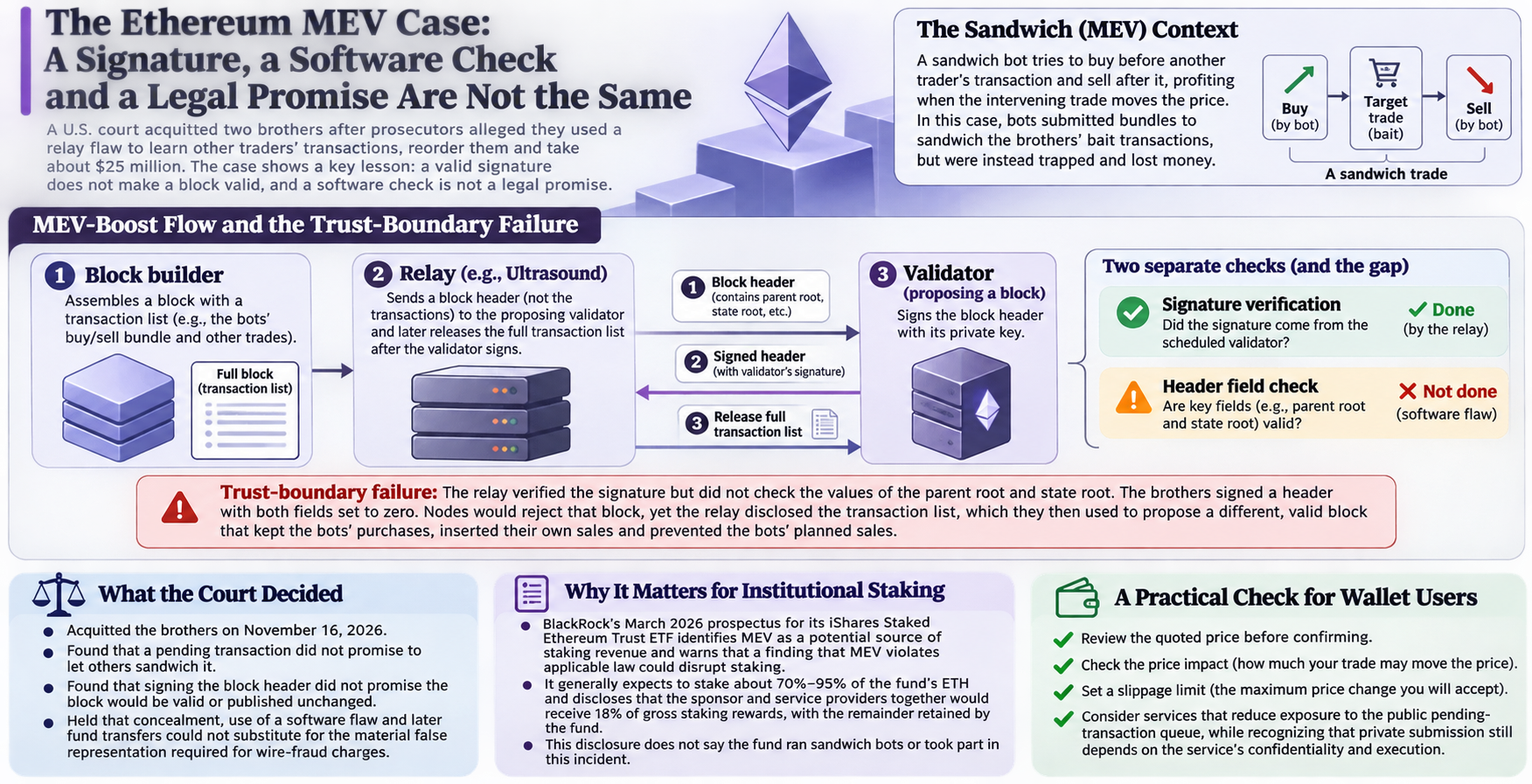
A sandwich bot tries to buy before another trader’s transaction and sell after it, profiting when the intervening trade moves the price. According to the court record, the brothers placed eight bait transactions in the public pending-transaction queue when a validator they controlled was due to propose a block on April 2, 2023. The bots submitted transaction bundles designed to sandwich those trades.
Under the MEV-Boost process described in the case, a relay first gives a proposing validator a block header. After the validator signs it, the relay releases the full block contents. The Ultrasound relay checked that the signature belonged to the scheduled validator, but its software did not verify the values of two critical header fields: the parent root and state root. The brothers signed a header with both fields set to zero. Ethereum nodes would reject that block, yet the relay disclosed the transaction list.
The court record says the brothers then used what they had learned to propose a different, valid block: it kept the bots’ purchases, inserted the brothers’ sales and prevented the bots’ planned sales from completing. The case illustrates a specific trust-boundary failure: a genuine signature did not make the signed block valid, and the relay released information before checking fields it needed to check.
What the acquittal did—and did not—decide
Prosecutors argued that the bait transactions and signed header were deceptive promises. The judge found that a pending transaction did not promise to let others sandwich it, and that signing the header did not promise the block would be valid or published unchanged. The judge also said that concealment, use of a software flaw and later fund transfers could not substitute for the material false representation required for the wire-fraud charges. Because the money-laundering conspiracy charge depended on proceeds from that alleged fraud, it failed as well.
This was a ruling on those criminal charges, not a finding that every MEV strategy is lawful. It also does not erase the costs that sandwich trading can impose on ordinary users.
Why the case matters beyond the bots
BlackRock’s March 2026 prospectus for its iShares Staked Ethereum Trust ETF identifies MEV as a potential source of staking revenue and warns that a finding that MEV violates applicable law could disrupt staking. It generally expected to stake about 70%–95% of the fund’s ETH and disclosed that the sponsor and service providers together would receive 18% of gross staking rewards, with the remainder retained by the fund. That disclosure does not say the fund ran sandwich bots or took part in this incident.
For a wallet user, the manageable check is at the point of a trade: review the quoted price, price impact and slippage limit before confirming. Services that reduce exposure to the public pending-transaction queue may help, but private submission still depends on the service’s confidentiality and execution. The broader lesson of the case is to ask separately what the software verifies, what participants have promised and who bears a loss when either safeguard fails.