If you hold assets in an Ethereum wallet, the practical question is not whether you need a new key today. It is whether you could safely retain control of your account if its signature system eventually had to change.
In an article published on November 19, 2026, imToken described Ethereum’s post-quantum work as a long-term engineering effort, not a response to a quantum computer already capable of breaking wallet keys. Its central concern for holders is migration: changing how an account is authorized without losing control of the assets and application relationships attached to it.
Which parts of Ethereum face the risk?
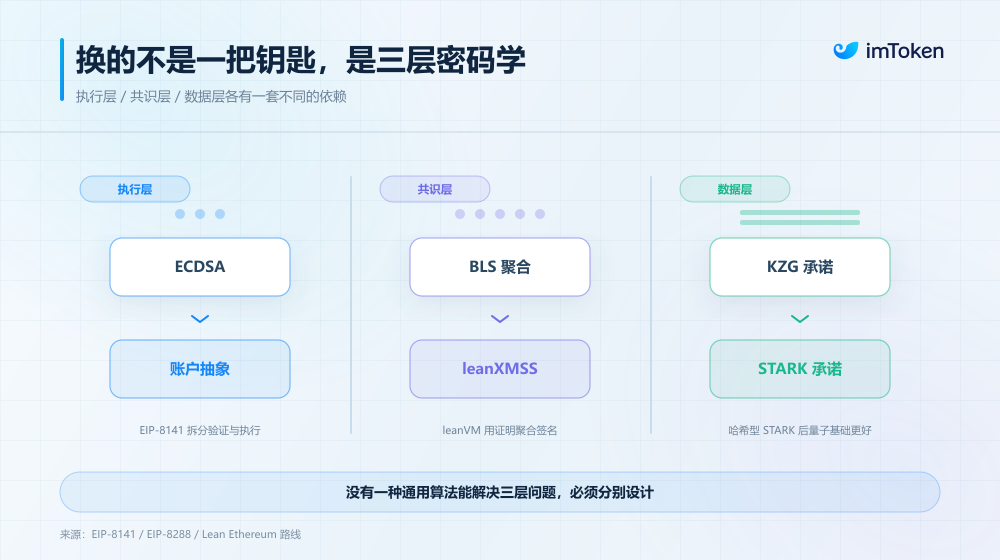
Ordinary Ethereum accounts use ECDSA signatures to authorize transactions. Validators use BLS signatures in proof-of-stake consensus. Both rely on elliptic-curve cryptography that a sufficiently capable, fault-tolerant quantum computer could theoretically undermine using Shor’s algorithm. Other components need separate consideration: KZG commitments used for blob and rollup data availability rely on elliptic-curve assumptions, as do some zero-knowledge proof systems.
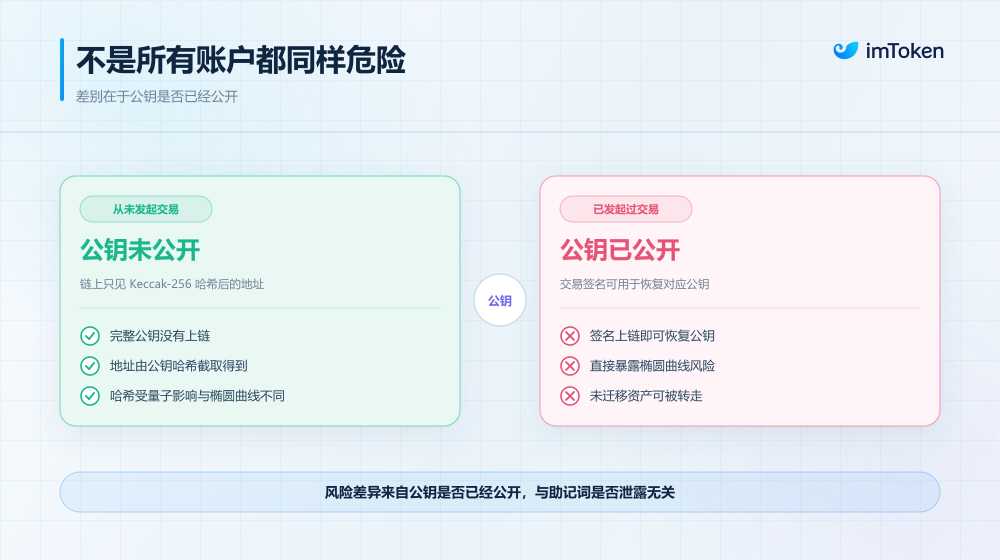
The exposure of an ordinary account also depends on what it has done. Its address is derived by hashing its public key. According to imToken, an account that has never sent an on-chain transaction or publicly disclosed an off-chain signature has not exposed its full public key in those ways. A transaction signature, including one for a contract approval, can reveal that public key. If elliptic-curve cryptography were eventually broken, that distinction would matter. It is not a reason to make a hurried transfer: imToken reported that no quantum computer capable of this cryptographic attack existed at the time of publication.
A target, not a completed upgrade
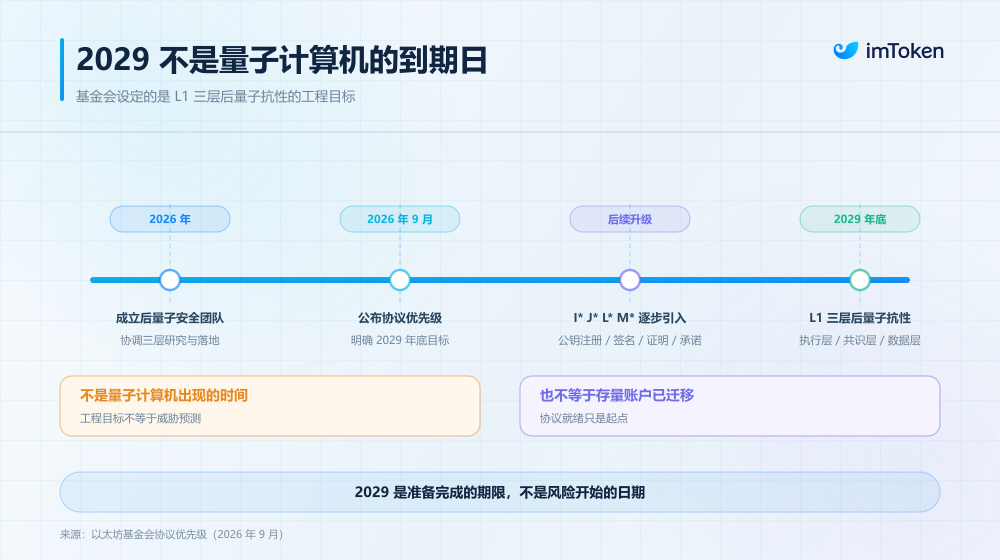
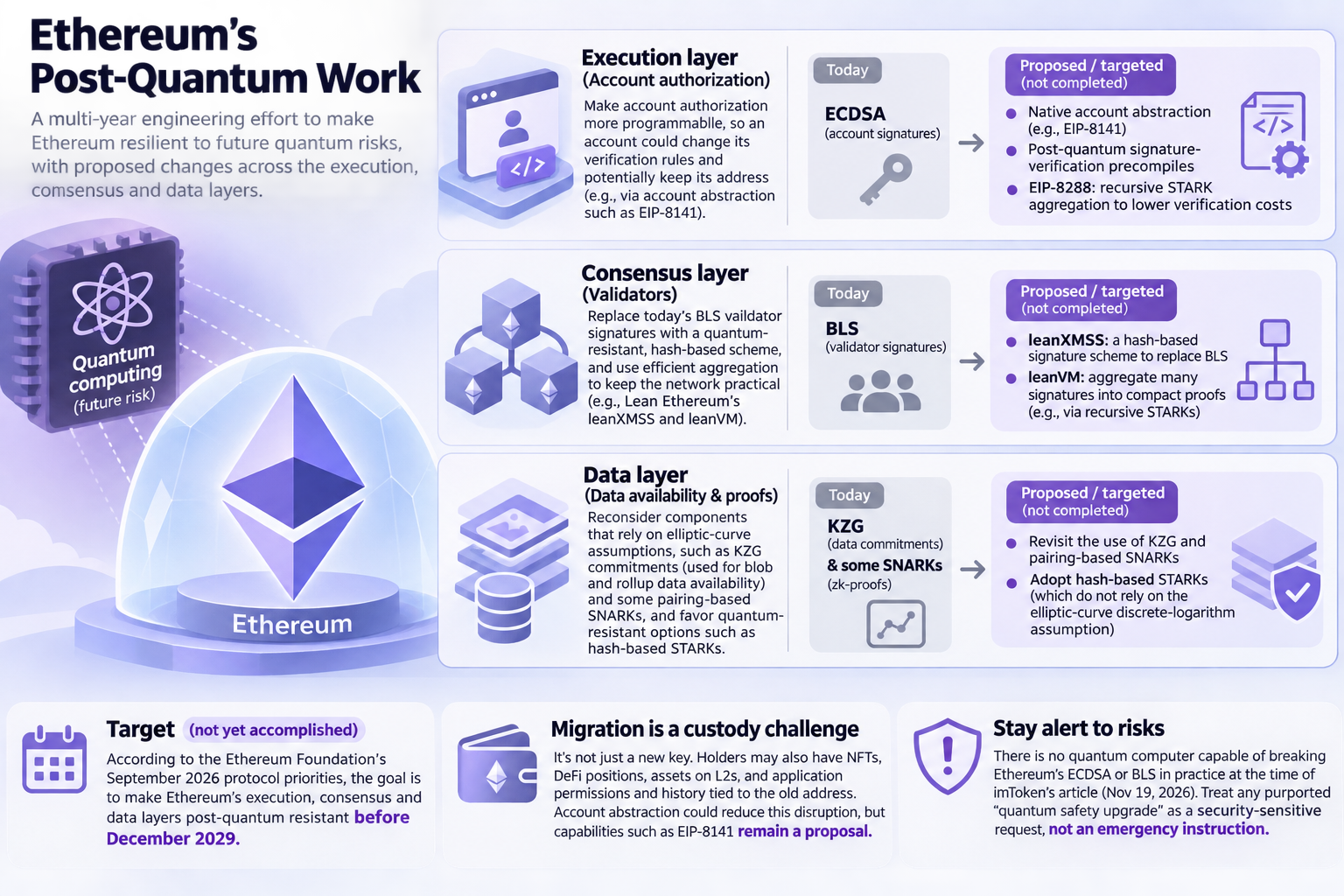
ImToken reported that the Ethereum Foundation formed a Post-Quantum Security team in 2026. It also said the foundation’s September 2026 protocol priorities set a goal of making Ethereum’s execution, consensus and data layers post-quantum resistant before December 2029. That is an engineering target, not an enacted protection for every account.
The proposed work addresses different problems at each layer:
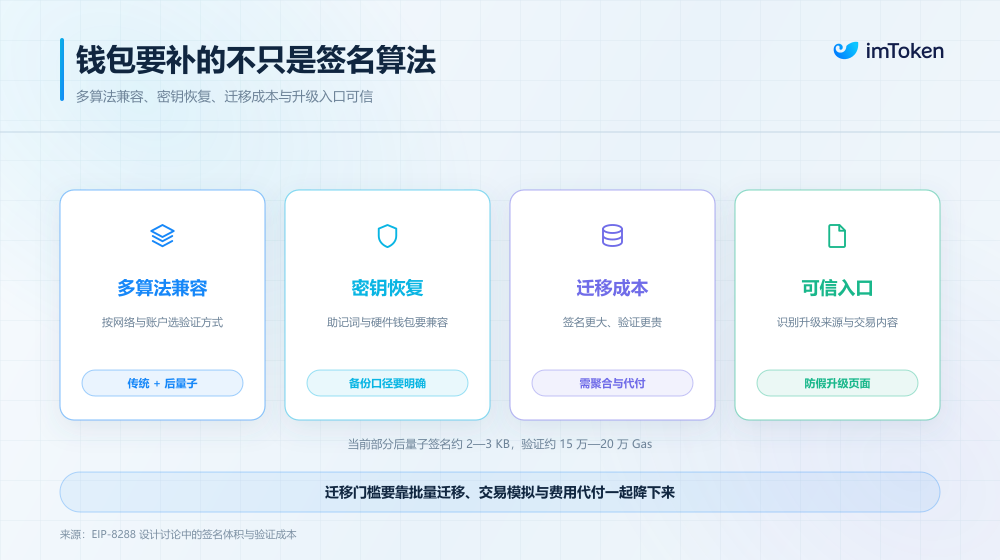
- Accounts: Native account abstraction, including the proposed EIP-8141, aims to make authorization more programmable. This could allow an account to change its verification rules and potentially retain its address while adopting a different signature system. Post-quantum signature-verification precompiles are also being studied.
- Verification costs: Post-quantum signatures are generally larger than today’s ECDSA and BLS signatures. EIP-8288 proposes using recursive STARK aggregation to reduce the on-chain burden of verifying many such signatures.
- Validators: The Lean Ethereum directions described by imToken include leanXMSS, a hash-based signature approach intended to replace validator BLS signatures, and leanVM, intended to help aggregate verification into compact proofs.
- Data and proofs: KZG commitments and some pairing-based SNARKs need consideration because of their underlying assumptions. Hash-based STARKs do not depend on the elliptic-curve discrete-logarithm assumption.
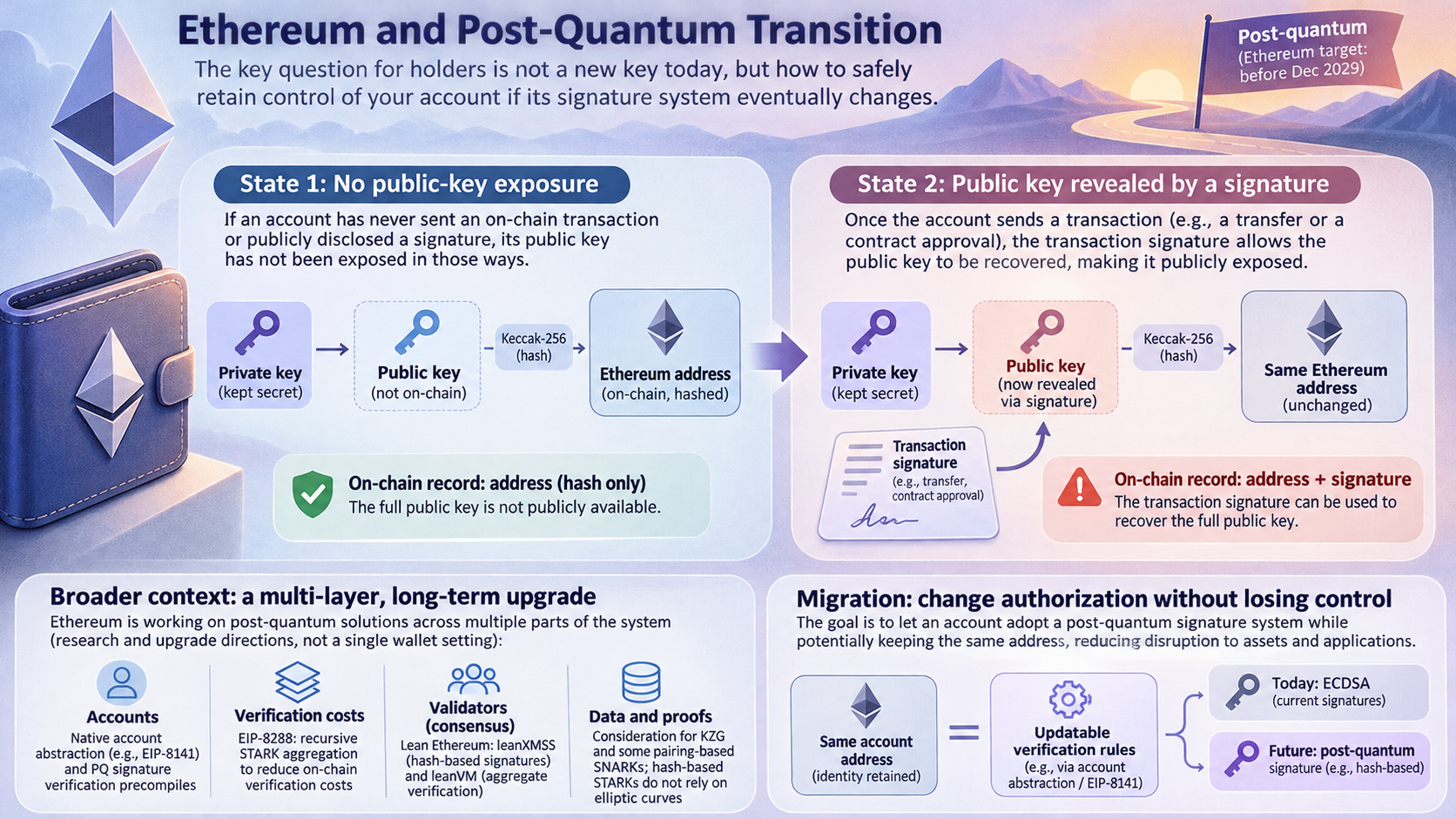
These are research and upgrade directions, not a single wallet setting users can switch on. Their scope also extends beyond Ethereum’s base layer to rollups and applications.
Why changing keys is a custody problem
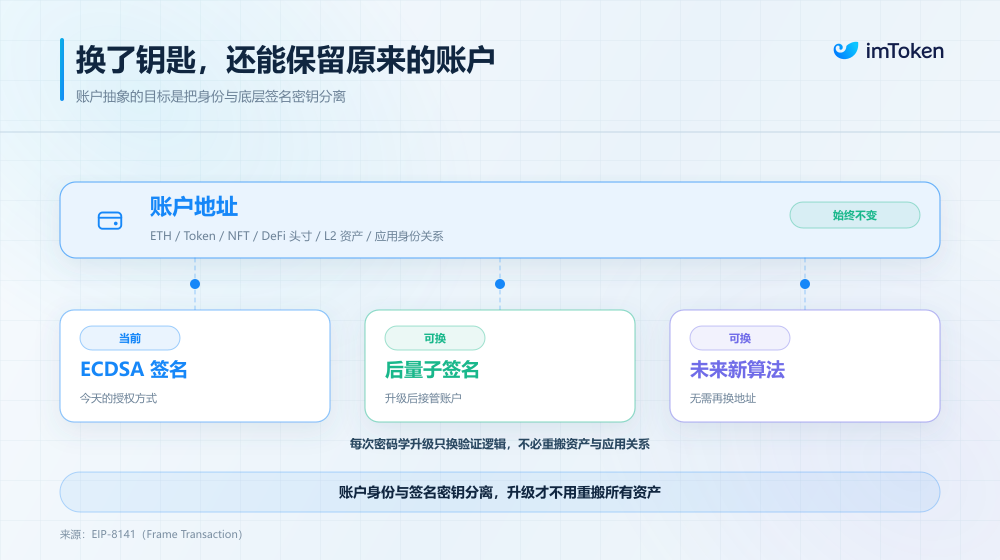
For a conventional externally owned account, adopting a new key system would ordinarily mean a new account address. Moving ETH or tokens is only part of the task: a holder might also have NFTs, DeFi positions, assets on different layer-2 networks, or application permissions and history tied to the old address. Account abstraction could reduce that disruption by separating the account’s identity from its underlying signing key, but the capability described in EIP-8141 remains a proposal.
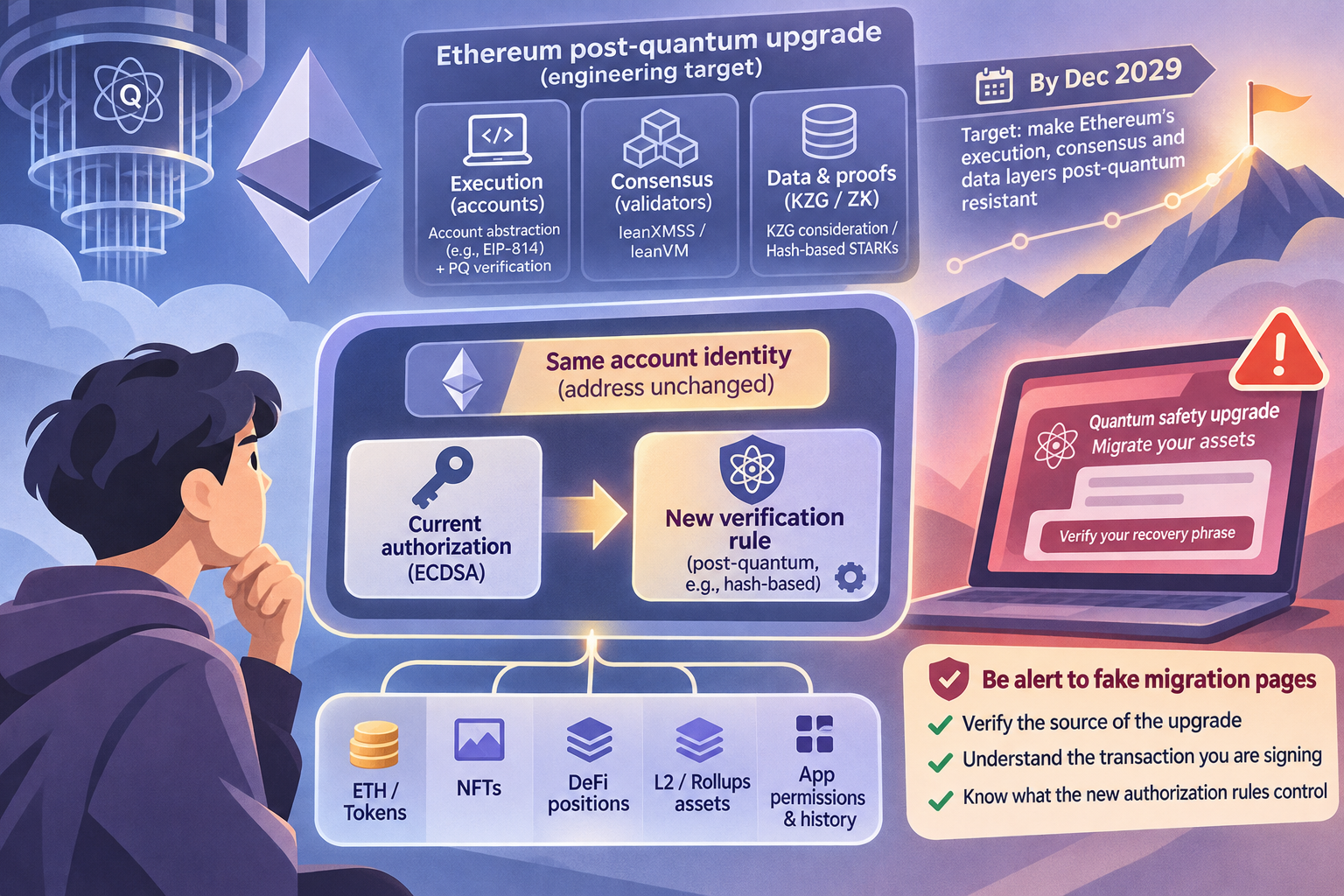
Timing matters, too. ImToken described an ideal migration as one authorized by the existing key while that key is still secure. If an attacker could already forge signatures from the old key, a signature alone could no longer reliably distinguish the owner from the attacker. Dormant accounts, lost keys and owners unaware of an upgrade pose a further unresolved problem. ImToken noted that whether such assets should remain at their addresses or face measures such as a governance-approved freeze remains disputed.
For now, the manageable habit is to treat any purported “quantum safety upgrade” as a security-sensitive request, not an emergency instruction. ImToken warned that fake migration or “private-key verification” pages could be used to solicit recovery phrases or malicious authorizations. Before approving a future account change, holders would need to establish where the upgrade comes from, understand the transaction they are signing and know what the new authorization rules would control. The article did not call for users to move assets immediately because of quantum computing.