For anyone planning to hold ETH for years, the practical question is whether an account will be able to move to a new signature scheme—and when that option will actually reach the network. As reported on November 10, 2026, Ethereum researchers were working toward a faster quantum-resistant transition than the Ethereum Foundation’s published schedule, while a separate hard-fork delay showed how difficult that timetable could be.
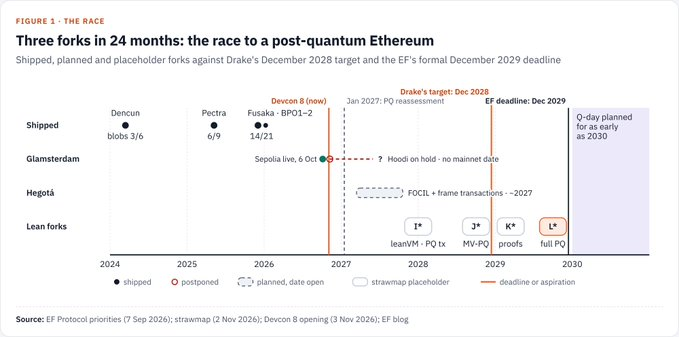
At Devcon 8 in Mumbai, Ethereum Foundation researcher Justin Drake said he hoped to complete a quantum-resistant and “post-AI” transition by December 2028. That is a research ambition, not an adopted deadline. The foundation’s published plan targets three layers of quantum resistance by December 2029 and says that date will not change before a review with external experts in January 2027.
What would change for accounts?
The roadmap places account flexibility before a full cryptographic transition. The proposed Hegotá fork, planned for 2027, would introduce frame transactions, allowing accounts to choose how they authorize transactions. That would create a route away from today’s ECDSA signatures without requiring a separate hard fork for every replacement scheme. Hegotá itself is not the quantum-resistant fork.
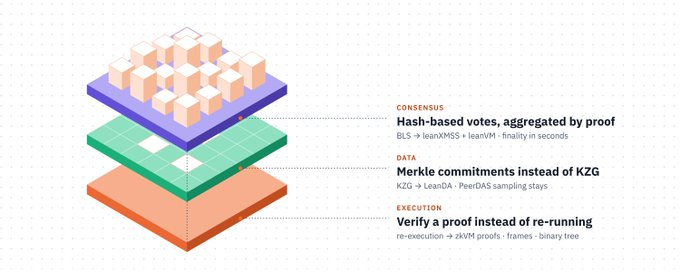
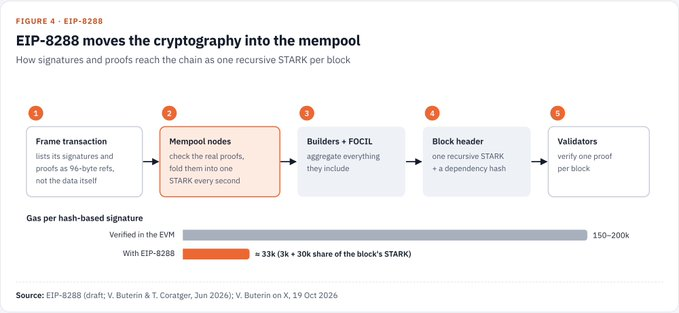
Later proposed forks would add quantum-resistant transactions, hash-based validator signatures and changes to data availability. A separate draft, EIP-8288, would aggregate signatures and proofs in the mempool rather than put every large signature directly on-chain. Its authors estimate that this could reduce the gas cost of a leanSPHINCS signature from 150,000–200,000 for direct verification to about 33,000 when aggregated. The proposal remains early: some details are undecided, its proof system has an unresolved soundness question, and it has no scheduled fork.
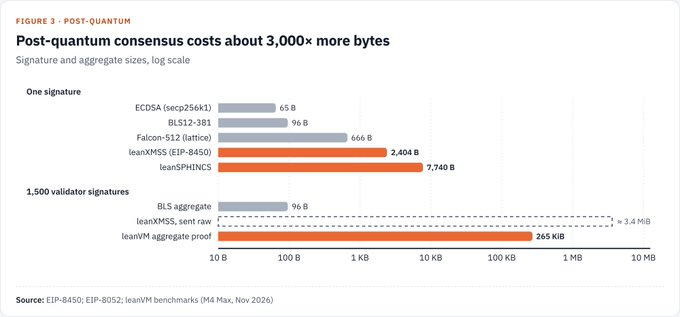
These designs do not mean holders can already switch their accounts to a production-ready quantum-resistant signature. The source also notes limits to a formal-verification claim about leanVM: Lean 4 work covers instruction semantics and constraint soundness, while the Rust implementation has undergone differential testing and recursive-proof soundness remains open.
Why the schedule matters
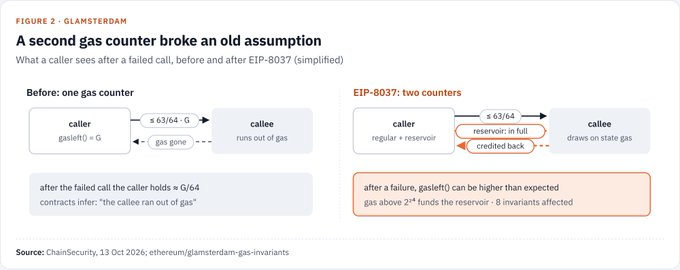
The faster goal would require three hard forks in roughly 24 months after Glamsterdam. Yet Glamsterdam had already encountered a compatibility problem. On October 22, it was withdrawn from a second testnet after a proposed gas repricing disrupted assumptions used by deployed contracts. ChainSecurity identified a way the change could allow error handlers that previously ran out of gas to finish, potentially bypassing checks against malicious interference. A coordinator for Ethereum’s All Core Devs meetings wrote that the setback would “very likely” push Glamsterdam’s mainnet release into 2027; no replacement mainnet date had been given in the November 10 report.
Hegotá’s proposed frame transactions list that repricing as a requirement, so the review matters to the account-migration path as well as to Glamsterdam. For a long-term holder, the useful distinction is between a proposed route to changing signatures and an available, tested way to use it. The open questions are whether the repricing can be resolved safely, when the dependent forks can ship, and which quantum-resistant mechanisms ultimately pass their remaining security work.