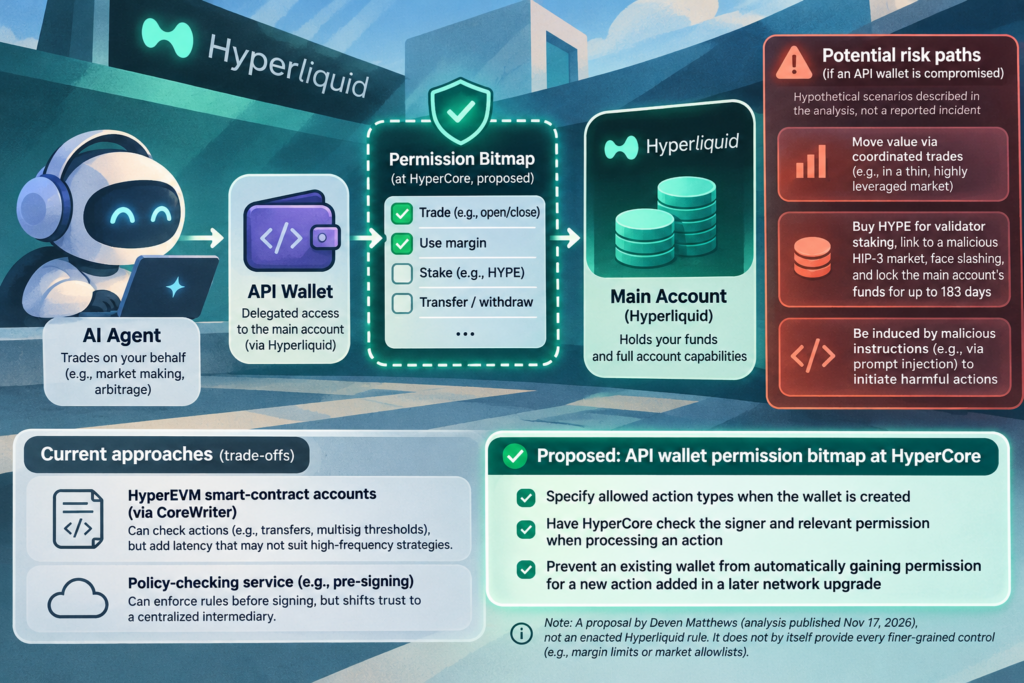
An AI agent that trades on someone’s behalf needs access to an account—but that access should not automatically extend to every action the account can take. In an analysis published on November 17, 2026, Deven Matthews argued that Hyperliquid’s API wallets have gained powers that make this boundary difficult to maintain. The article describes potential attack paths, not a confirmed theft or loss.
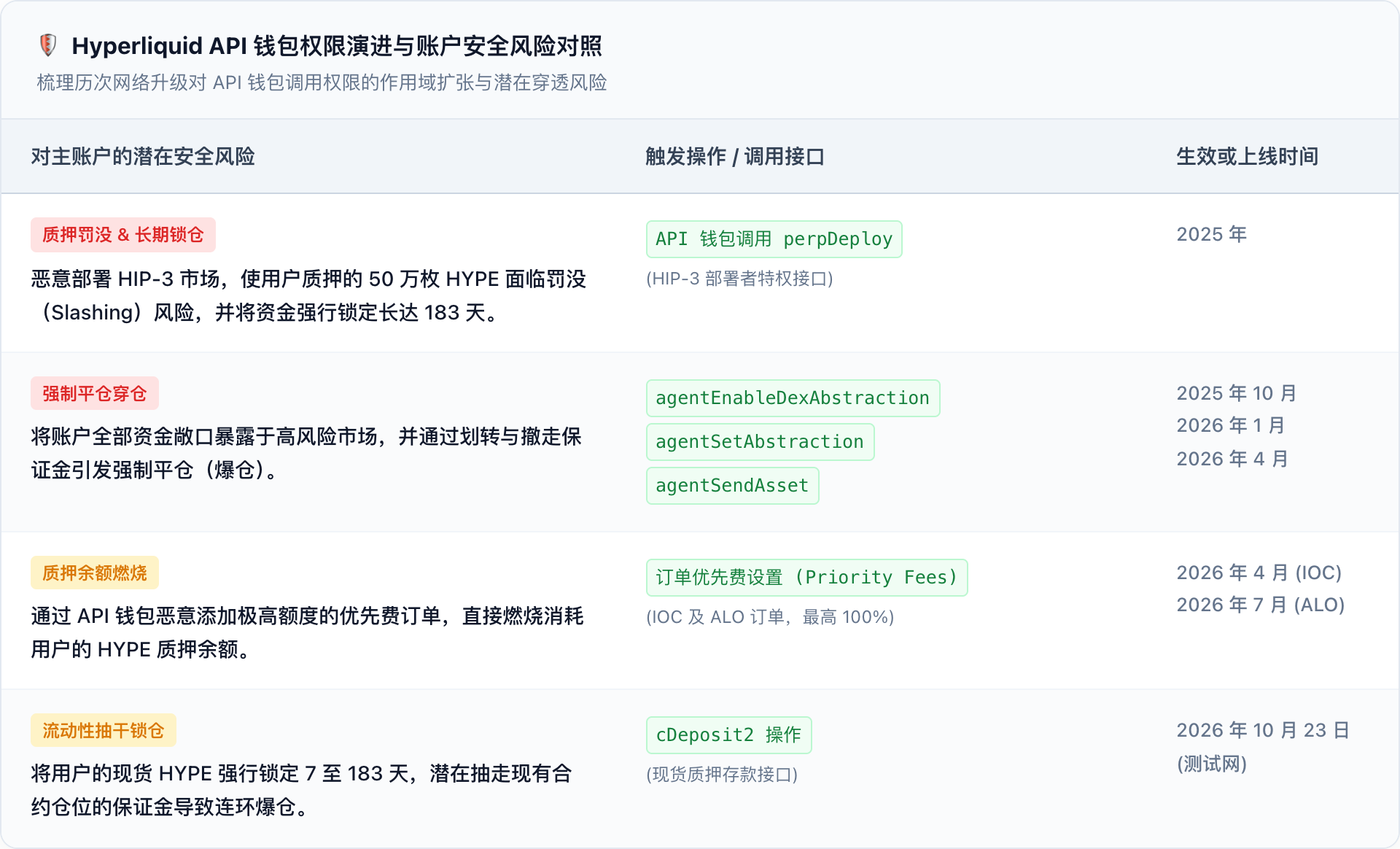
What could a compromised API wallet do?
API wallets were originally restricted from withdrawing directly from a main account or transferring funds to an external address, Matthews wrote. But their use of the account’s margin was not capped. In his assessment, a compromised wallet could therefore move value through coordinated trades in a thinly traded, highly leveraged market.
Matthews also pointed to permissions added as Hyperliquid expanded. He described a hypothetical account holding more than approximately $40 million: a maliciously controlled API wallet could buy 500,000 HYPE for validator staking, associate the stake with a malicious HIP-3 market, expose it to slashing, and lock the main account’s funds for up to 183 days. These are claimed capabilities and risks, not reported outcomes of an incident.
The concern is particularly relevant to agents that interact with untrusted material online. Matthews argued that an attacker might not need to steal an API wallet’s private key: malicious instructions placed in an agent’s decision-making context could instead induce the agent to initiate harmful actions. The article does not establish that such an attack has occurred.
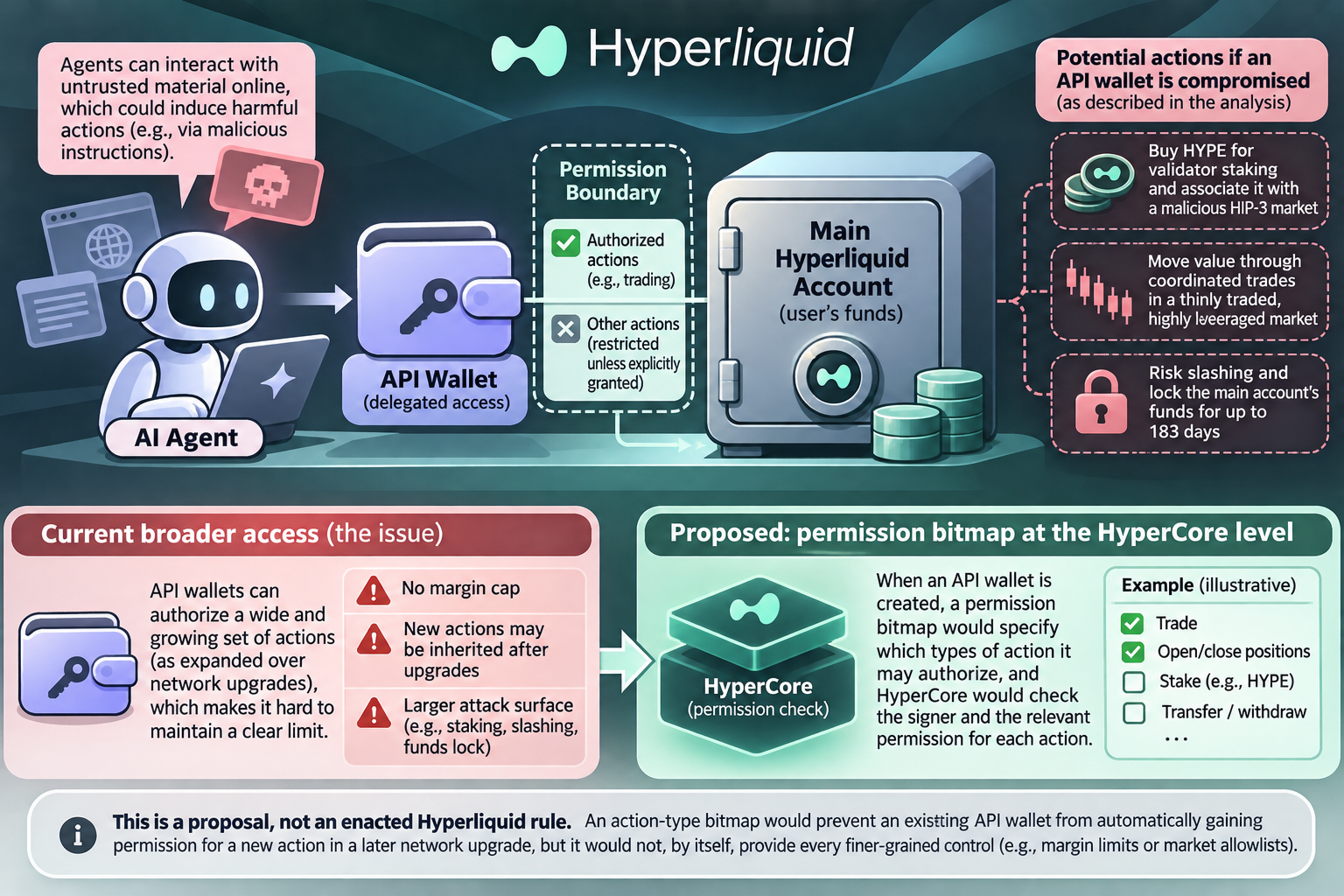
Why existing controls may not be enough
Matthews described HyperEVM smart-contract accounts as a way to check actions such as transfers and multisignature thresholds before they reach HyperCore through CoreWriter. His trade-off is latency: sending frequent trades through Solidity checks may not meet the timing needs of strategies such as market making or arbitrage. Direct API-wallet access avoids that path but, in his view, leaves broader permissions in place. He also noted that a service that checks policies before signing can shift trust to a centralized intermediary.
His proposed alternative is a permission bitmap for API wallets at the HyperCore level. When a wallet is created, the bitmap would specify which types of action it may authorize. HyperCore would check the signer and the relevant permission when processing an action. Matthews compared the approach with restricted permissions already used for HIP-3 sub-deployers.
Crucially, his proposal would prevent an existing API wallet from automatically gaining permission for a new action introduced in a later network upgrade. It is a proposal, not an enacted Hyperliquid rule. Nor would an action-type bitmap, by itself, provide every finer-grained control discussed in the article, such as margin limits or market allowlists.
For someone considering delegated trading access, the practical question raised by the analysis is what the agent’s wallet can actually authorize—including actions added after that wallet was created. Keeping an agent’s instructions or signing process secure matters, but it is not a substitute for understanding that permission boundary.