If you rely on a social login to recover a wallet, the practical question is not just whether recovery is easy. It is who must keep which parts of that process secure.
In an article published on November 10, 2026, at 14:04 (UTC+8), Liu Jiaolian reported that assets had been transferred from several thousand Keplr social-login wallet accounts. According to the article, Keplr attributed the incident to a vulnerability in Web3Auth’s infrastructure. Liu said the specific cause had not been disclosed in detail and described disagreement between the providers. His analysis of where the failure might have occurred is a hypothesis, not a confirmed explanation of the incident.
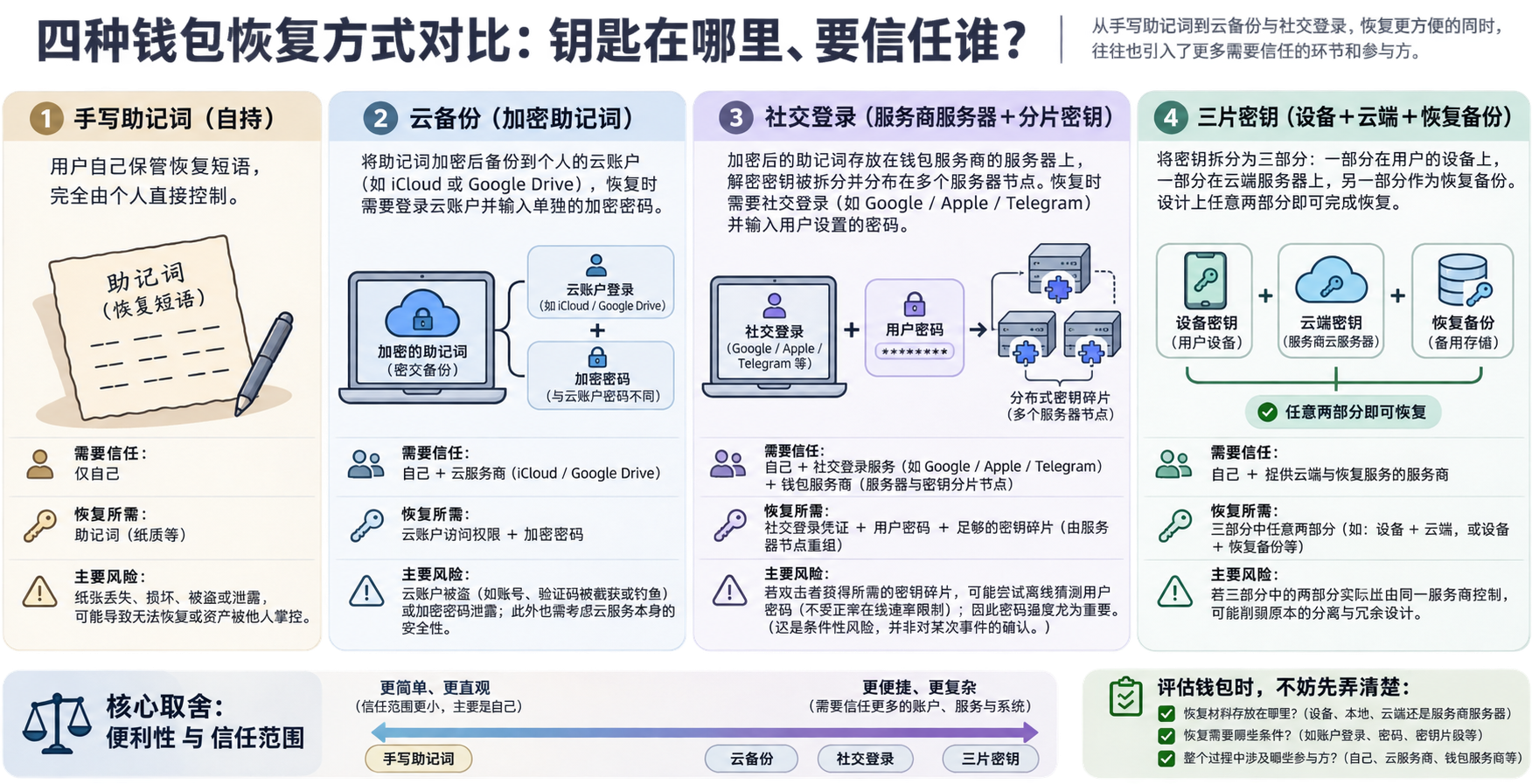
Four ways to handle wallet recovery
Liu compared four approaches, excluding exchanges that hold full control of customers’ assets:
- A handwritten recovery phrase: The user holds the phrase directly. Loss, damage, theft or disclosure of the paper can put recovery—or the assets—at risk.
- Uniswap Wallet’s cloud backup: As Liu describes it, an encrypted recovery phrase is backed up to the user’s iCloud or Google Drive. Recovery requires access to that cloud account and a separate password used to encrypt the phrase. The cloud copy helps with accessibility, but protecting the account and encryption password remains important.
- MetaMask social login: In Liu’s account, the encrypted phrase sits on MetaMask’s servers, while parts of the decryption key are distributed among server nodes. Recovery uses a Google, Apple or Telegram login and a user-set password. He argues that if an attacker obtained the necessary key fragments, they could attempt password guesses offline, beyond the normal online rate limit. That is a conditional risk, not a finding that this happened.
- Keplr’s social-login arrangement: Liu describes a three-part key setup involving the user’s device, a cloud server and a recovery backup, with any two parts sufficient for recovery. He suggests that control of two parts by one provider could undermine the intended separation. He explicitly says further technical disclosure is needed to establish what happened in this incident.
The trade-off is between a recovery method that is easier to use and the additional parties or systems it may require users to trust. A paper phrase makes the user’s responsibility more visible, but it can be lost. A cloud or social-login path may reduce that particular burden while introducing account, password or service dependencies. When assessing a wallet, a useful check is to establish where the recovery material is held, what is required to restore access, and which parties participate in that process—without assuming that a more complex design is either automatically safer or automatically weaker.
Source: techflowpost.com (originally published 2026-11-10 14:04 UTC+8)