For anyone relying on a smart contract to hold assets, the key question is not just whether a tool found a bug. It is which properties the tool checked, and whether those properties capture the intended behavior.
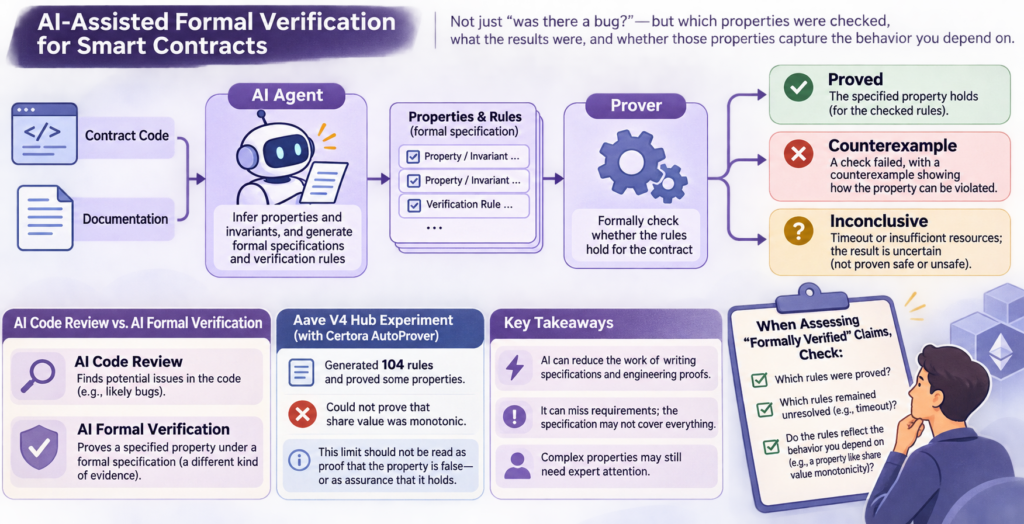
An article published on November 11, 2026, describes an AI-assisted formal verification workflow: an AI agent infers properties and invariants from contract code and documentation, turns them into formal specifications and verification rules, and passes those rules to a prover. A failed check can produce a counterexample. A timeout or insufficient resources, however, leaves the result uncertain—not proven safe or unsafe.
That is a different kind of evidence from an AI code review. A proof addresses a specified property; it does not establish that the specification includes every requirement. AI may reduce the work of writing specifications and engineering proofs, but it can miss requirements, and complex properties may still need expert attention.
The article describes a Certora AutoProver experiment on Aave V4 Hub in which the tool generated 104 rules and proved some properties. It could not prove that share value was monotonic. That limit should not be read as proof that the property is false—or as assurance that it holds.
For readers assessing a contract’s security claims, the practical check is to look beyond a headline stating that it was “formally verified”: ask which rules were proved, which remained unresolved, and whether the rules reflect the behavior users depend on.