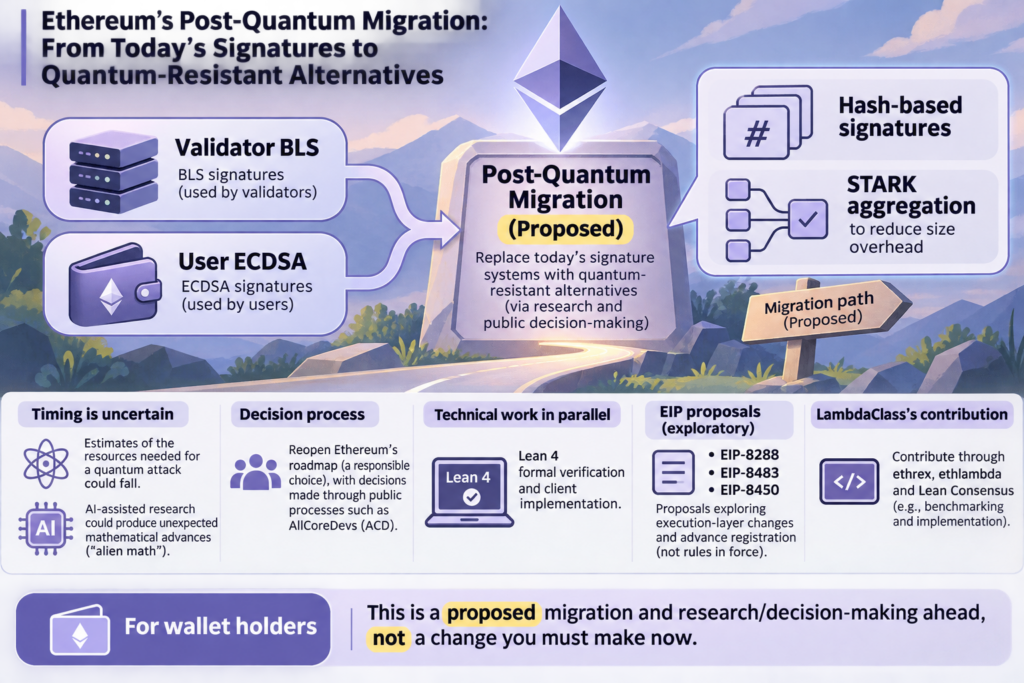
For people holding assets in an Ethereum wallet, the post-quantum question is about whether today’s signature systems can be replaced without disrupting access. In a summary published on November 17, 2026, LambdaClass argued that Ethereum needs to complete its post-quantum cryptography migration by the end of 2028. That is LambdaClass’s assessment, not an enacted network deadline.
LambdaClass identified two systems that would need attention: BLS signatures used by validators and ECDSA signatures used by users. It favored exploring hash-based signatures, with STARK-based signature aggregation to reduce their size overhead. It also discussed EIP-8288, EIP-8483 and EIP-8450 as proposals exploring execution-layer changes and advance registration—not rules already in force.
The timing remains uncertain. LambdaClass noted that estimates of the resources needed for a quantum attack could fall and raised the possibility of AI-assisted research producing unexpected mathematical advances, which it called “alien math.” It argued that reopening Ethereum’s roadmap would be a responsible choice, with decisions made through public processes such as AllCoreDevs (ACD). In parallel, it called for Lean 4 formal verification and client implementation, and said it would contribute through ethrex, ethlambda and Lean Consensus.
For wallet holders, the practical distinction is between a proposed migration and a change they must make now. The summary describes research and decision-making ahead; it does not announce a new wallet requirement.