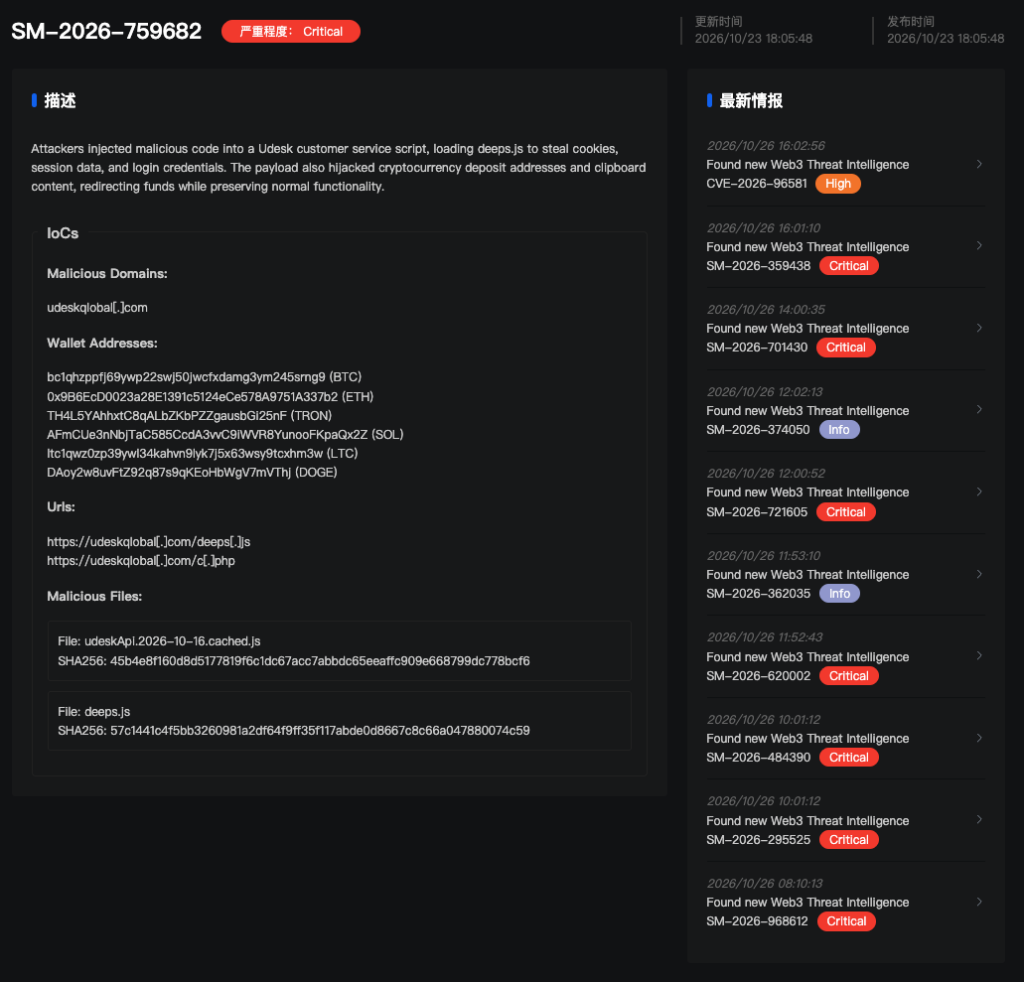
A deposit address shown on a website is not necessarily the address the site intended to display. In an analysis published on October 27, 2026, SlowMist reported finding malicious code loaded through a Udesk-related customer-support script. Its analysis identified two separate risks: collection of data accessible to the webpage, and replacement of deposit addresses on certain sites. The report did not establish that any user lost funds.
How the code reached the page
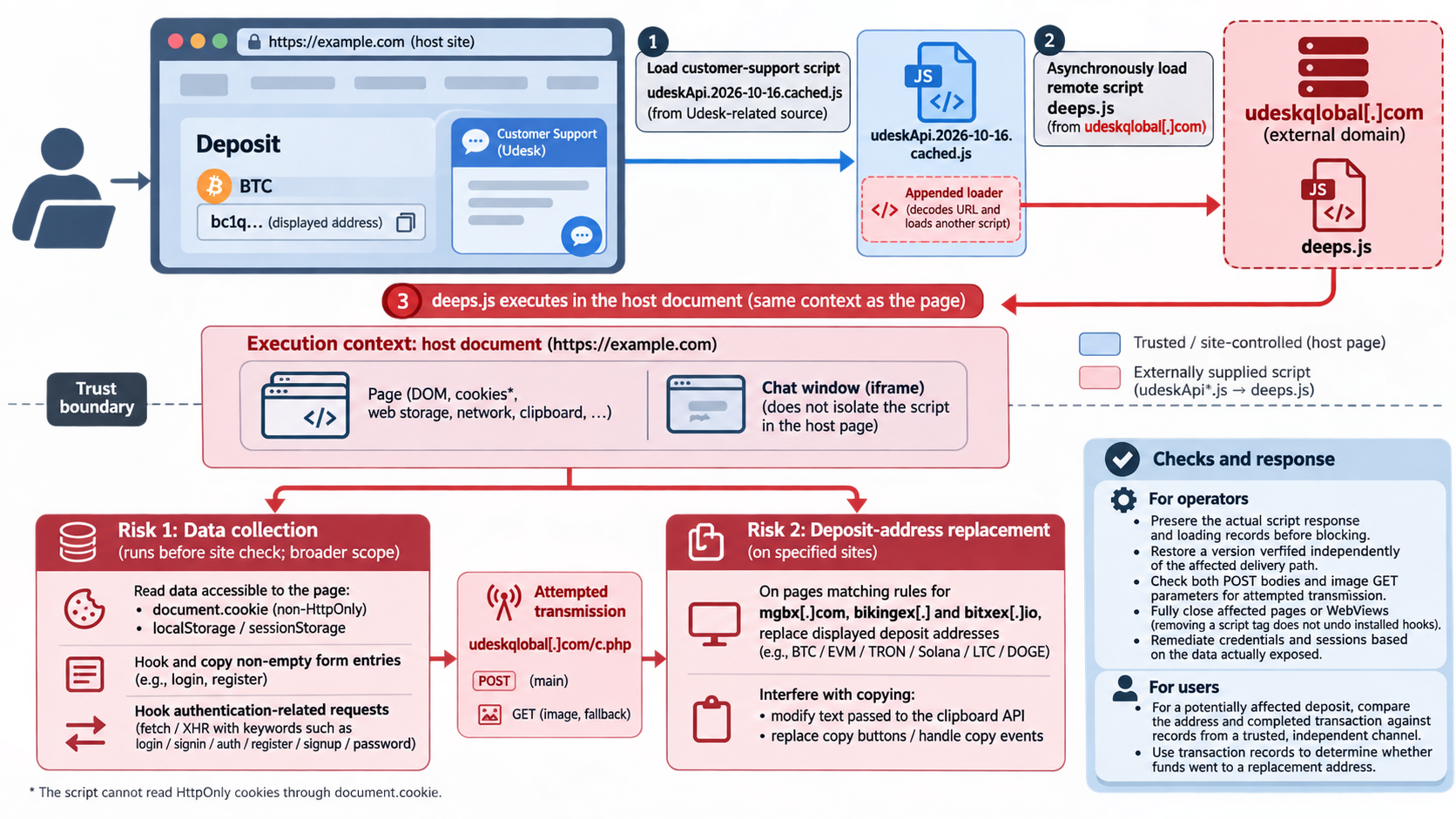
SlowMist examined udeskApi.2026-10-16.cached.js and found a loader appended after the customer-support code. It decoded a URL and asynchronously loaded deeps.js from udeskqlobal[.]com—spelled with a q in “qlobal.” If the browser loaded that script, it ran in the context of the document that included it. A chat window’s iframe would not, by itself, isolate a script loaded into the host page.
Two risks with different scopes
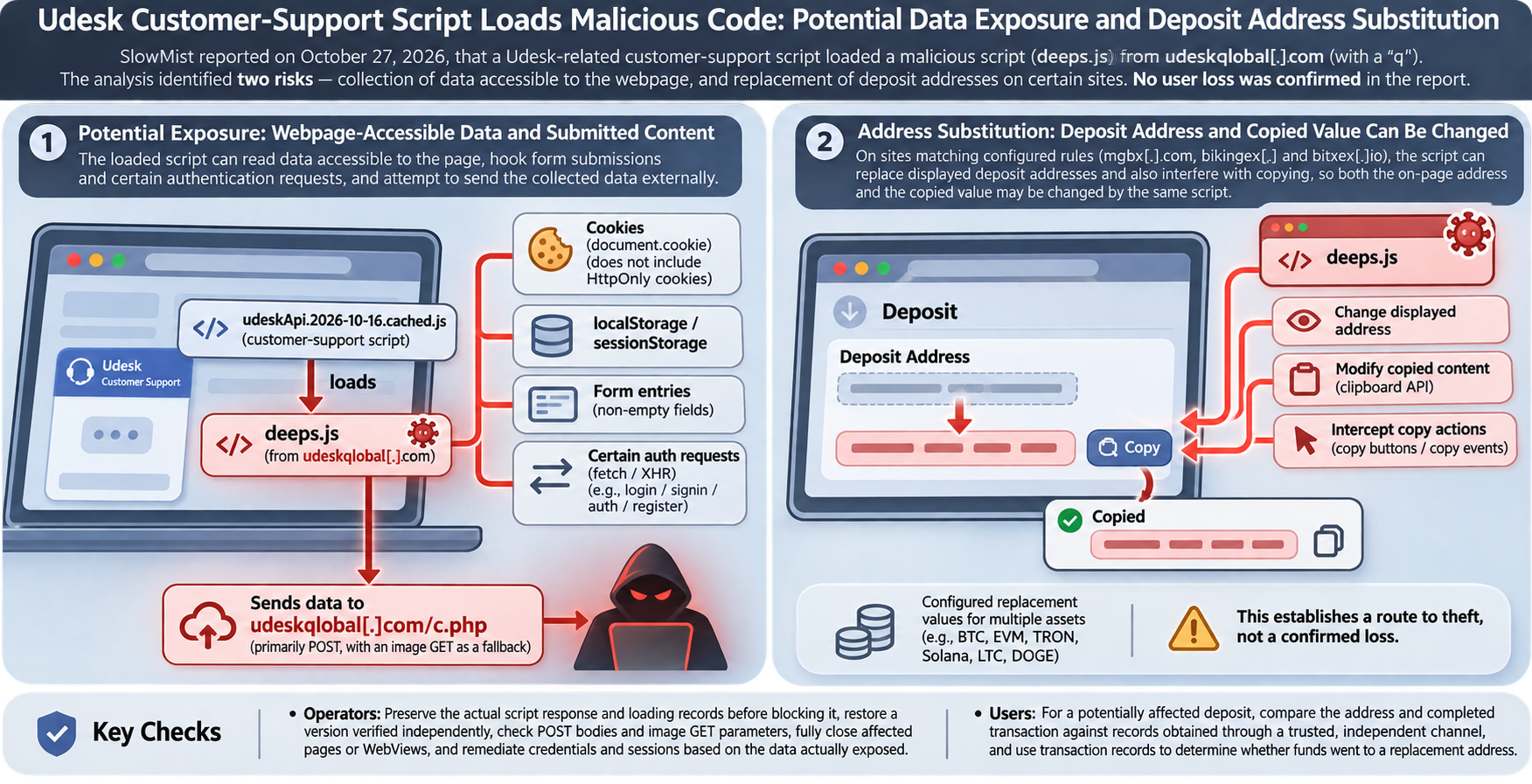
According to SlowMist, deeps.js first read cookies accessible through document.cookie, plus localStorage and sessionStorage. It also installed hooks that could copy non-empty form entries and the bodies of certain authentication-related fetch and XHR requests. Whether useful credentials were exposed depends on what an affected page actually held or submitted. The script could not read HttpOnly cookies through document.cookie.
The collection code ran before a check for three configured site patterns. That means the potential data exposure was not confined to the sites targeted by the deposit-address changes. SlowMist traced attempted transmission to udeskqlobal[.]com/c.php, primarily through POST requests, with an image GET request as a fallback. A browser CORS error would not, on its own, prove that a request was never sent.
After the site check, the script could alter displayed deposit addresses on pages matching rules for mgbx[.]com, bikingex[.] and bitxex[.]io. It also interfered with copying: one hook changed text passed to the clipboard API, while others targeted copy buttons or copy events. As a result, comparing a displayed address with a value copied from the same affected page would not necessarily provide an independent check. SlowMist identified configured replacement values for BTC, EVM, TRON, Solana, LTC and DOGE, but did not report confirmed transfers to them.
Checks for affected operators and users
Operators still serving the script should preserve the actual script response and loading records before blocking it, then restore a version verified independently of the affected delivery path. SlowMist recommends checking both POST bodies and image GET parameters for attempted data transmission. Removing a script tag alone does not undo hooks already installed in an open document; affected pages or WebViews should be fully closed. Credential and session remediation should follow the data actually exposed.
For a potentially affected deposit, the practical check is to compare the address and completed transaction against records obtained through a trusted, independent channel, rather than relying on the displayed address and copy button on the same page. Transaction records are needed to determine whether funds went to a replacement address. The reported behavior establishes a route to theft, not a confirmed loss.