For anyone waiting on a cross-chain transfer, the essential question is whether the destination router has actually received the funds—not merely whether a message about the transfer has been authenticated. In an analysis published on August 22, 2026, SlowMist said an attacker exploited that distinction in Allbridge’s CCTP integration on August 19, taking approximately $190,000.
What the message proved—and what it did not
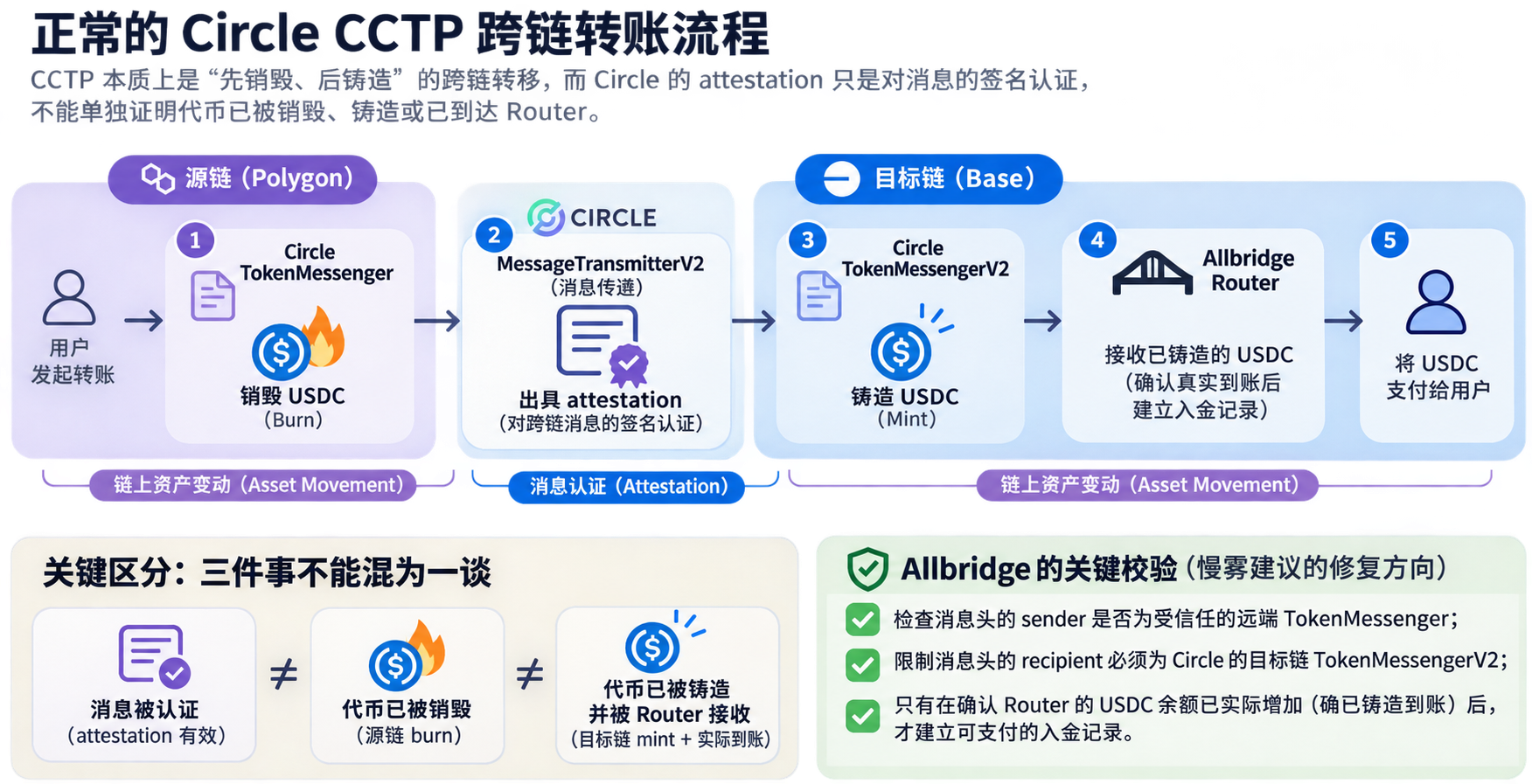
Circle’s CCTP normally burns USDC on the source chain and mints the corresponding amount on the destination chain. Circle also provides an attestation, a signature authenticating a cross-chain message. SlowMist explained that an attestation alone does not prove USDC was burned, minted or received by Allbridge’s Router.
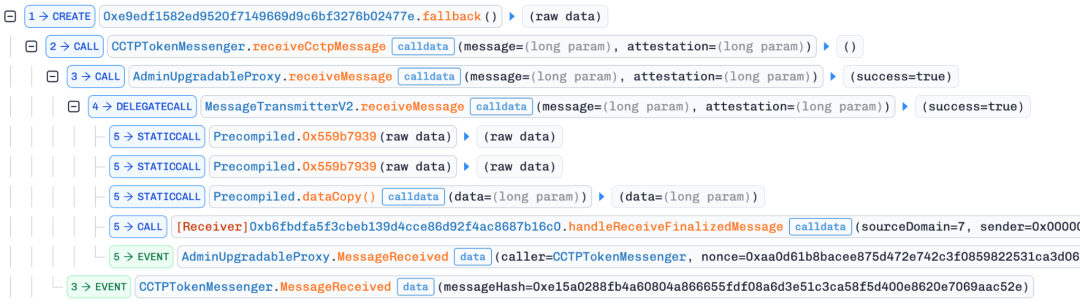
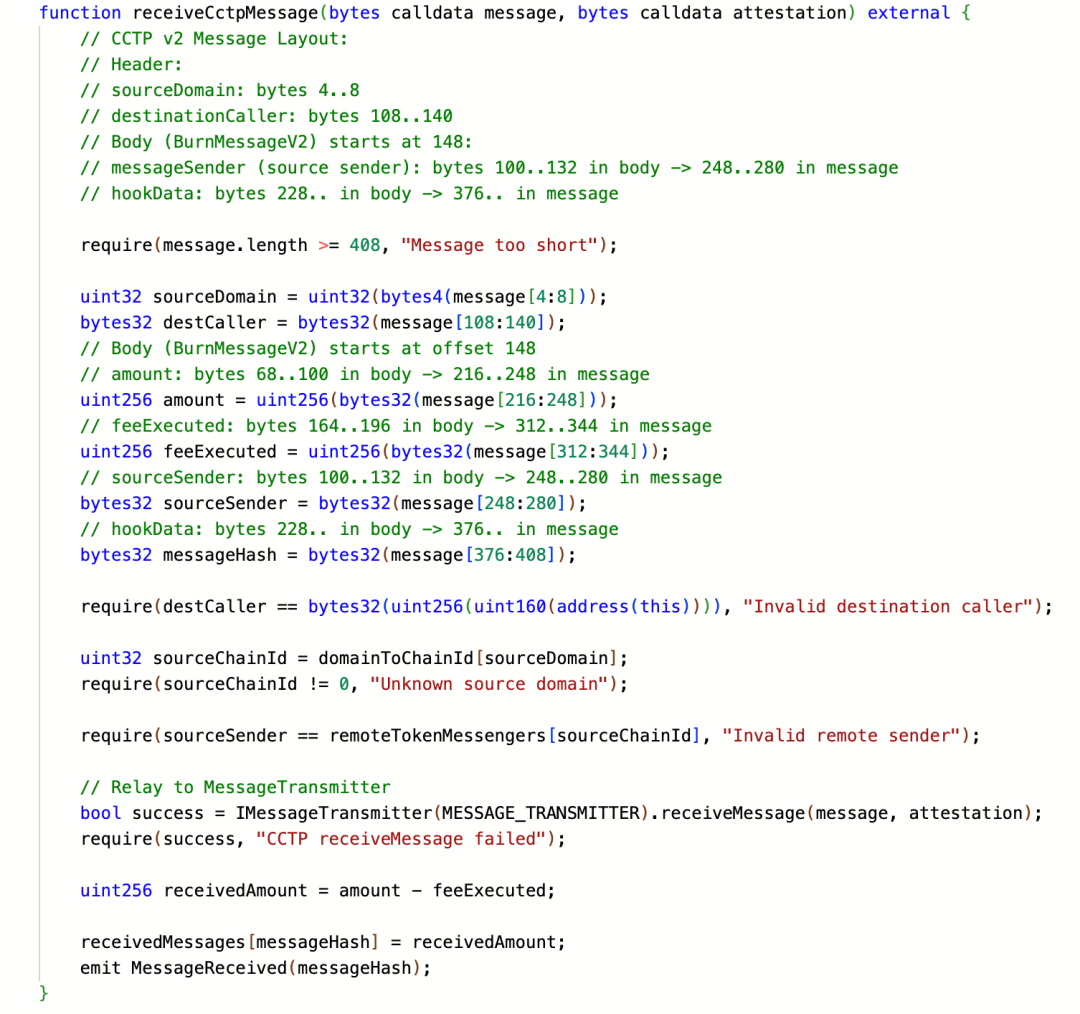
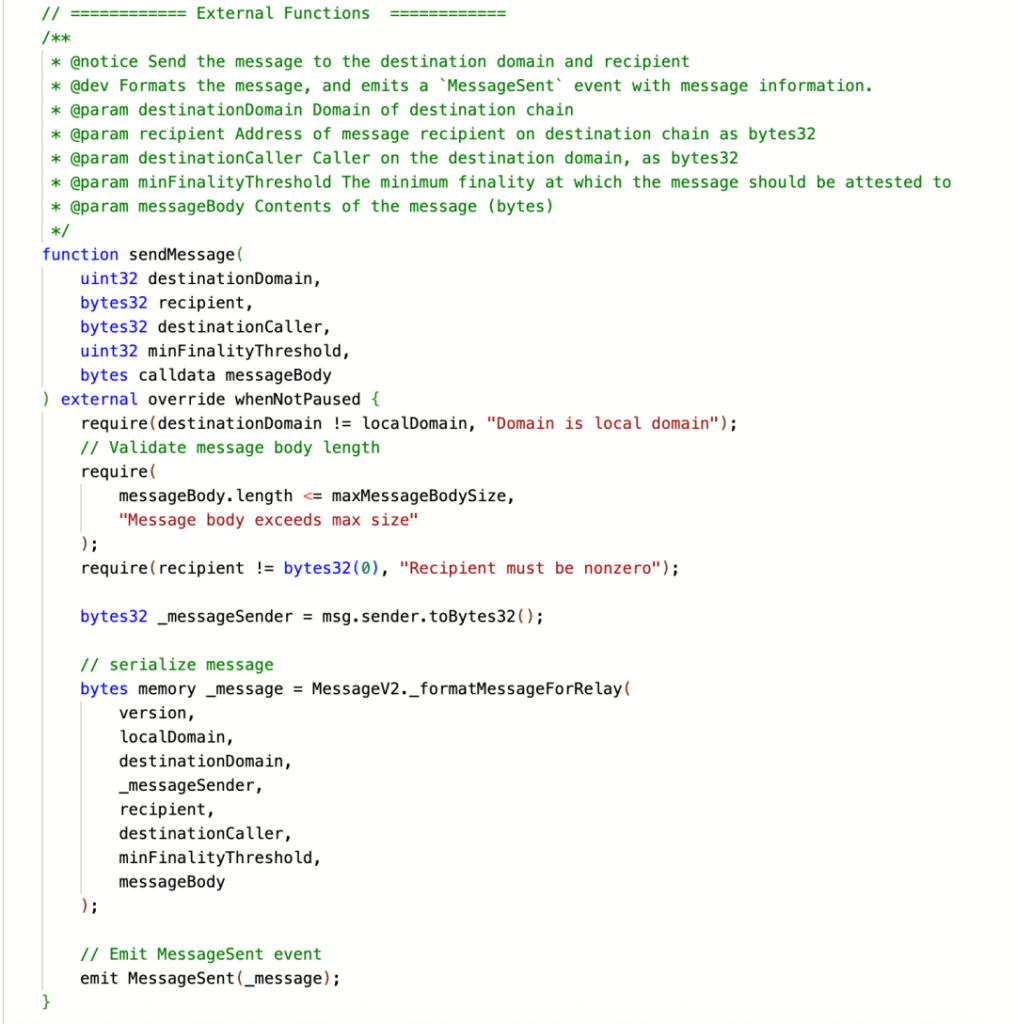
According to SlowMist, the attacker called Circle’s general-purpose MessageTransmitterV2.sendMessage function directly on Polygon on July 26, 2026. The call produced a message that Circle subsequently attested to, but it did not burn USDC. The attacker made the message resemble a CCTP transfer to Base, declared an amount of 1,000,000 USDC and included a precomputed Router messageHash in its hookData.
How the Router’s balance became vulnerable
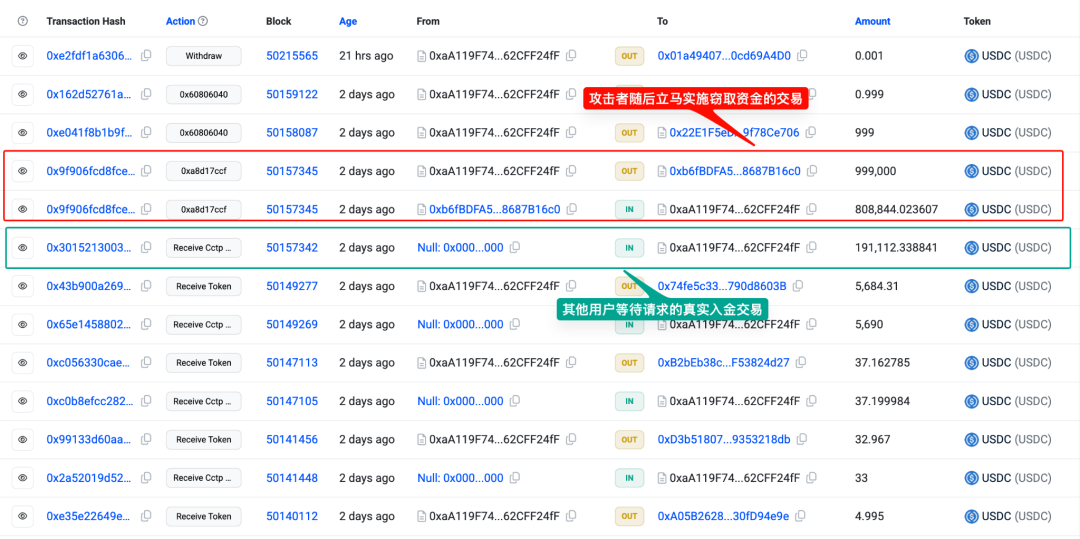
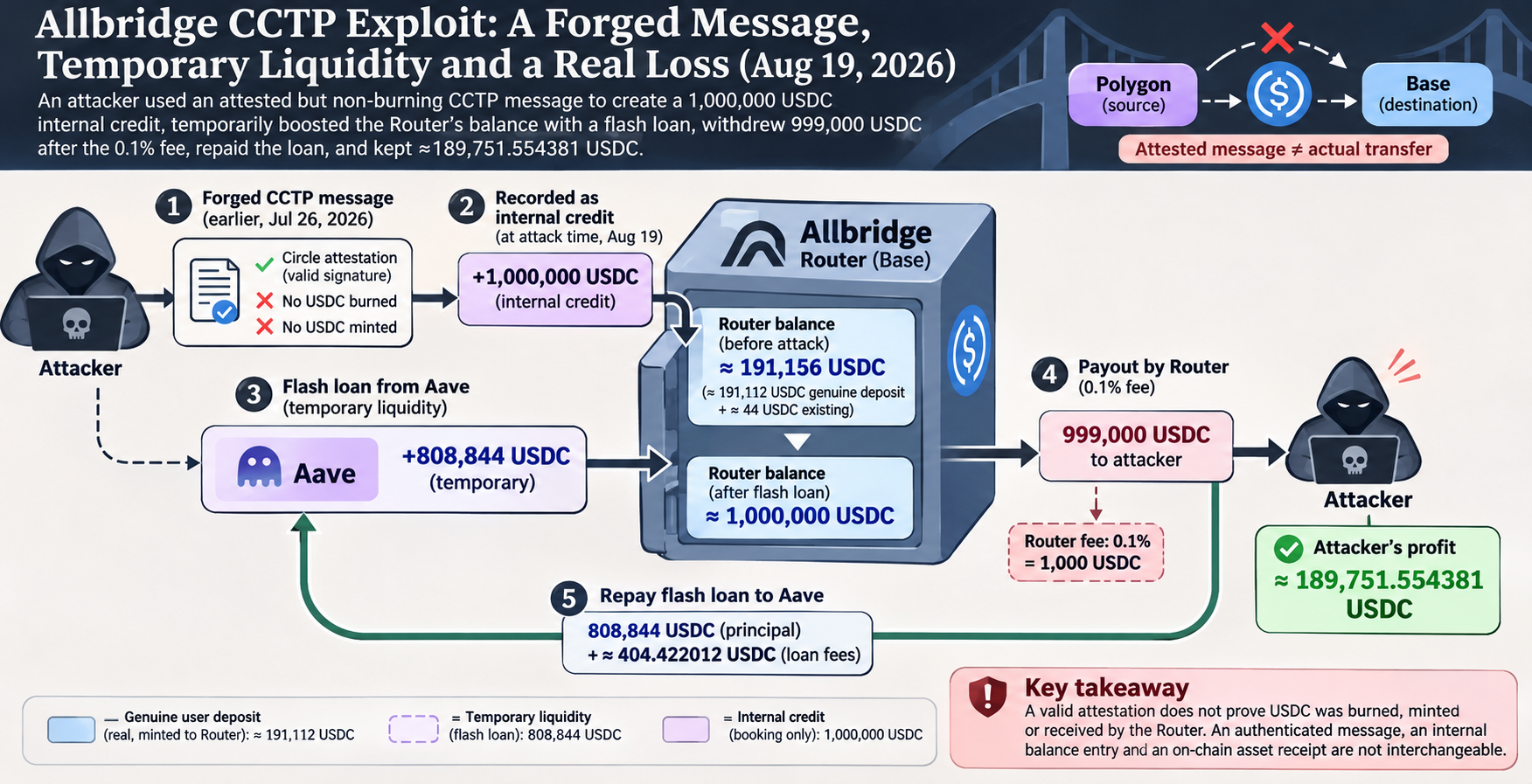
SlowMist said the attacker waited about 24 days. On August 19, a genuine CCTP deposit of approximately 191,112 USDC was minted to the Base Router for another user, bringing its balance to approximately 191,156 USDC. Six seconds after that deposit, the attacker began the transaction that used the earlier message.

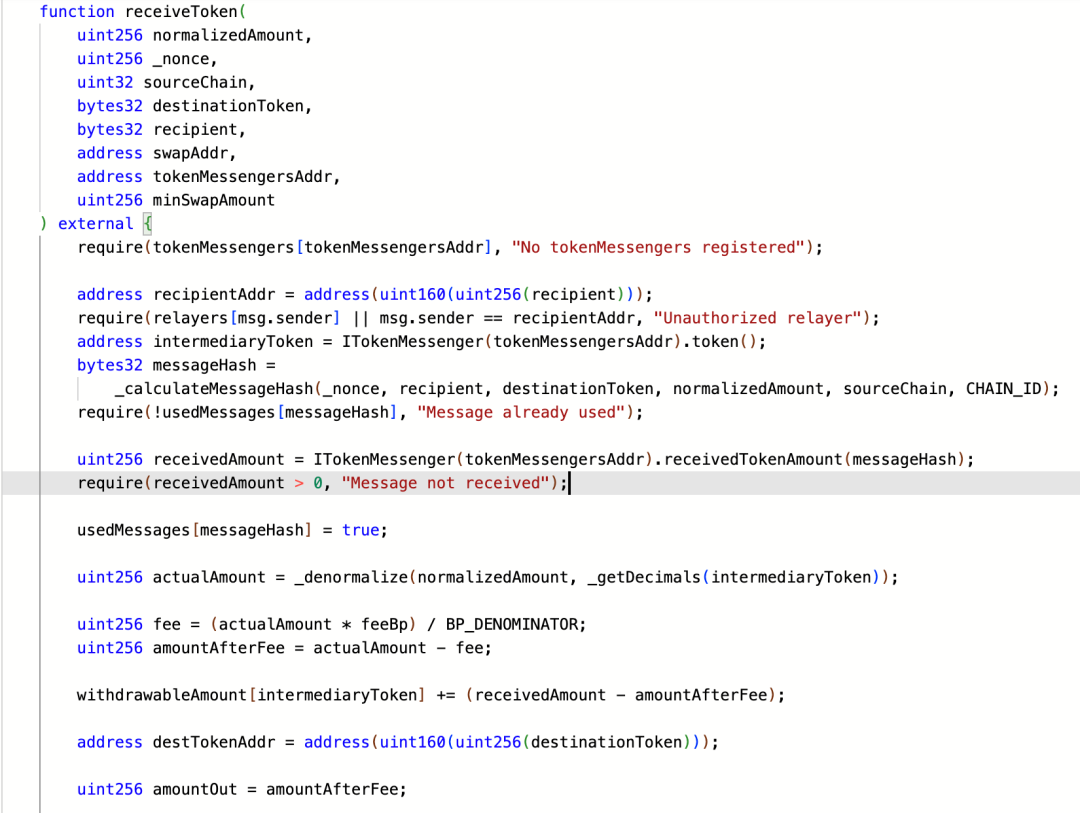
In SlowMist’s account, Allbridge’s CCTPTokenMessenger.receiveCctpMessage did not check that the message header’s sender was the trusted remote TokenMessenger or that its recipient was Circle’s destination-chain TokenMessengerV2. When Circle’s message receiver followed the attacker-specified recipient, it called the attacker’s contract, which returned success without minting USDC. Allbridge then recorded the message’s declared amount as an internal credit without checking that the Router’s USDC balance had increased by that amount.
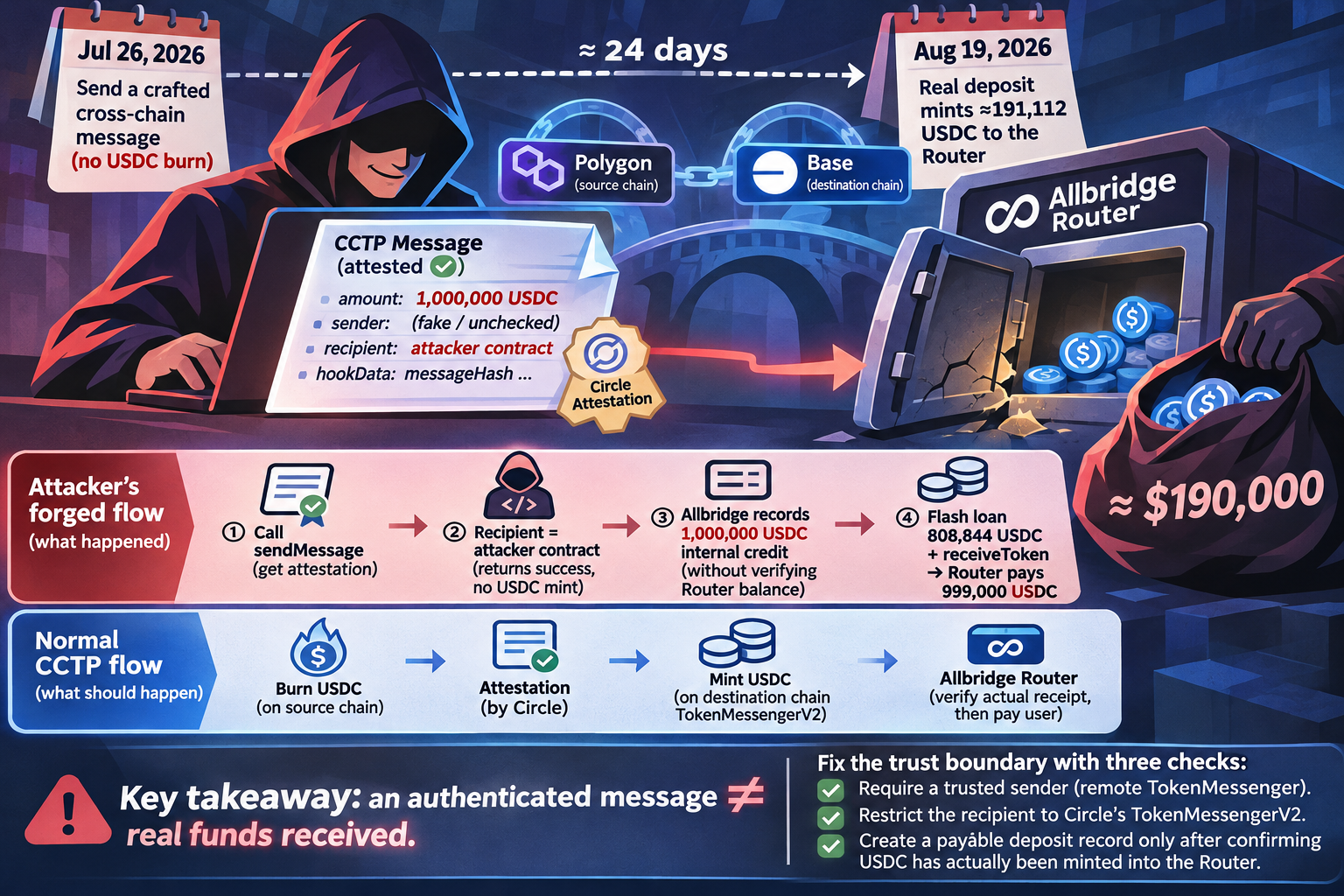
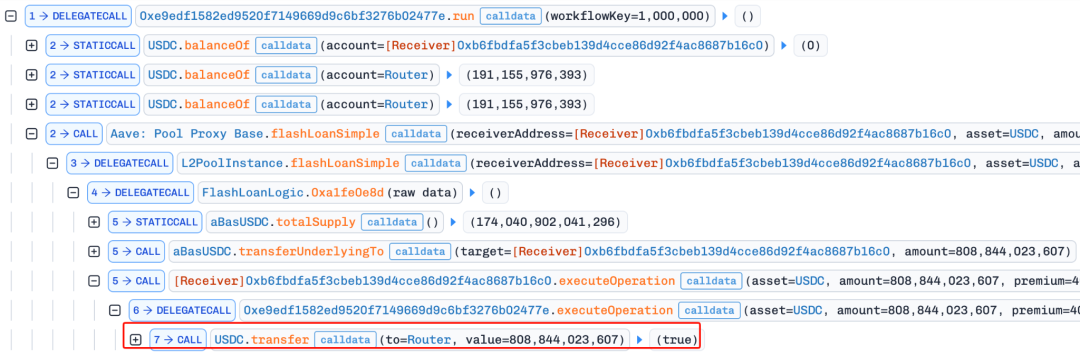
The Router held far less than the forged 1,000,000 USDC credit. SlowMist said the attacker temporarily supplied 808,844 USDC through an Aave flash loan, then called receiveToken. The Router matched the call’s calculated hash to the attacker’s precomputed messageHash and treated the recorded credit as a deposit. After a 0.1% Router fee, it sent 999,000 USDC to the attacker’s contract.
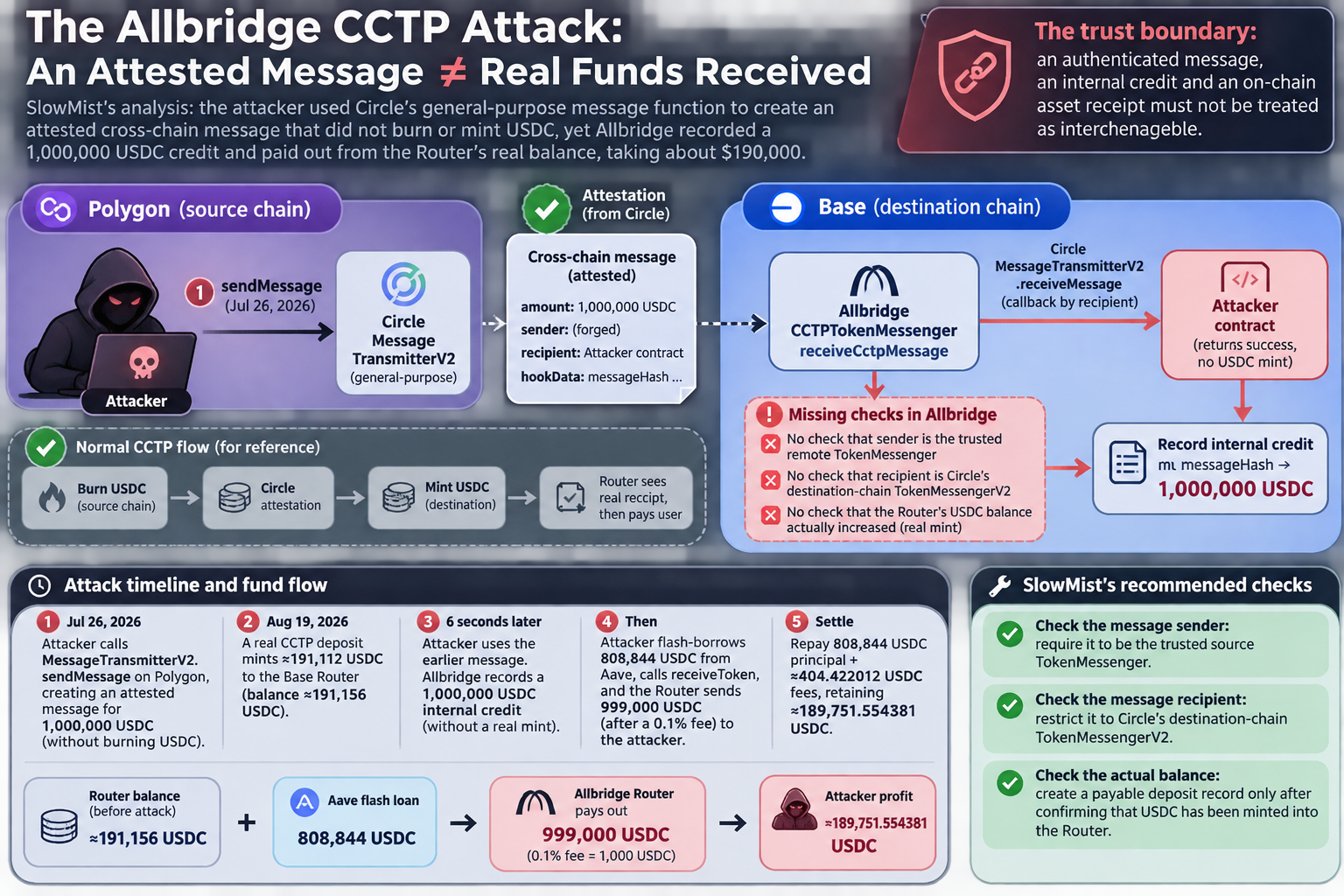
SlowMist reported that the attacker repaid the 808,844 USDC flash-loan principal and approximately 404.422012 USDC in loan fees, retaining approximately 189,751.554381 USDC. The Router’s pre-existing balance was almost entirely depleted; SlowMist said the loss came mainly from genuine cross-chain funds that had arrived but had not yet been forwarded to their intended user. It also reported that other attackers later used the same method to take the 1,000 USDC Router fee.
The trust boundary
SlowMist’s recommended fixes address three separate checks: require the message header’s sender to identify a trusted source contract; restrict its recipient to Circle’s destination-chain TokenMessengerV2; and create a payable deposit record only after confirming that USDC has actually been minted into the Router. The incident illustrates why an authenticated message, an internal balance entry and an on-chain asset receipt must not be treated as interchangeable.