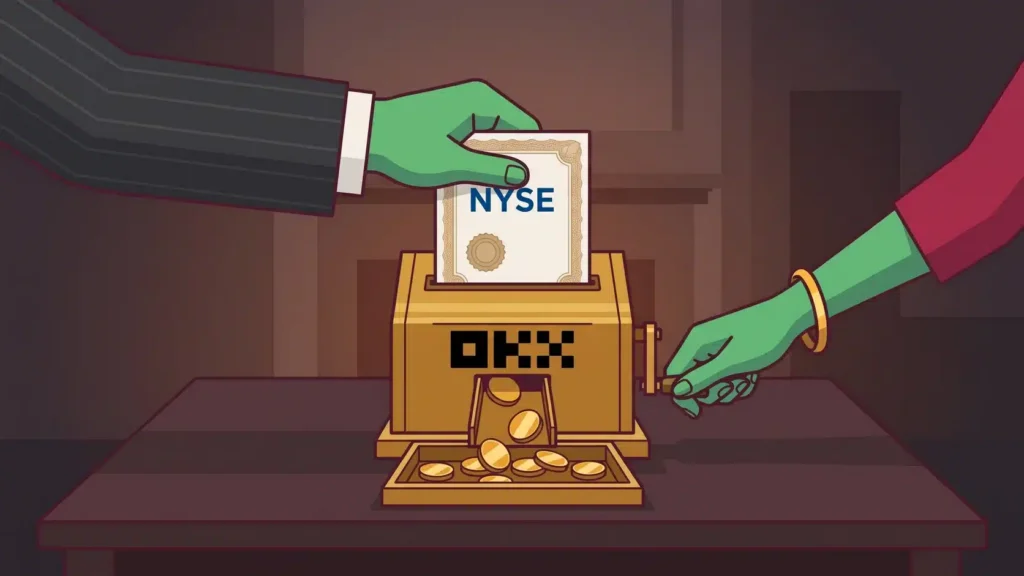
Readers who keep assets for the long term need a clear picture of which wallet actually holds a token and what can still stop that wallet from moving it. In an announcement reported on November 23, 2026, OKX and Intercontinental Exchange (ICE), owner of the New York Stock Exchange, said eligible U.S. customers of OKX would be able to buy tokenized shares through OKXICE, the venture the firms formed, when its venue goes live at 12 p.m. ET that Monday. The company said those wallets would stay in the customer’s own custody.
The setup is a trade-off between access and control, not a claim that risk disappears. Only vetted users were to be admitted. Buyers had to be eligible U.S. customers of OKX Inc. who passed identity checks, and the venue’s smart contracts were described as blocking any wallet that had not been approved from trading or supplying liquidity. Approval governs whether a wallet can reach the market, while the keys, and any backup of those keys, remain the holder’s responsibility. Self-custody here does not remove the chance of a lost backup, a compromised device, or a failed recovery, and an unapproved wallet cannot trade or add liquidity. A check that follows directly from the notice is to confirm a wallet is approved before counting on it, and to keep a separate backup that does not depend on the exchange login.
The venture announced the launch earlier that Monday. It said the venue would appear as a new tab in the OKX app and that 113 stocks, ETFs, and exchange-traded products were slated to be added in stages from November 23. That was up from the more than 70 assets named when the date was set on November 11. The new names were eToro, Fidelity Investments, Strive, and Vida Global, joining Better.com, BitGo, Circle, Coinbase, Direxion, Robinhood, Securitize, and Strategy. A public notice dated November 20 listed six stocks as available at the planned launch, each paired with USDC: Coinbase, Securitize, Strategy, BitGo, Robinhood, and Circle.
The same notice named 67 companies that objected to tokenized versions of their shares trading on the venue, including Apple, Microsoft, Nvidia, and Tesla. The tally was unchanged from the November 5 notice.
Securitize, which trades on the NYSE as SECZ, was identified as the firm tokenizing the shares. Each token, the announcement said, is backed by one real share and passes through dividends and voting rights. Trades were to settle against automated market maker pools built with Uniswap v4 on X Layer, OKX’s Ethereum layer-2 network. The notice said pool prices are set by each pool’s asset ratio, not the underlying stock’s market, so they can drift, especially after hours. A holder would need to treat that possible gap as part of the position rather than assume the token matches the listed share at every moment.
The announcement said the venue would run under the SEC’s Innovation Exemption, temporary conditional relief the agency issued in September. The exemption lets qualifying venues trade tokenized versions of U.S.-listed stocks if they meet conditions such as limits on trading volume. When a stock is tokenized by a third party unaffiliated with the company, the venue must notify the company in writing and wait at least 30 calendar days before trading it; an objection within that window keeps the stock off the venue. OKXICE, the company said, would also allow objections after that window. Jamie Selway, director of the SEC’s Division of Trading and Markets, said on Unchained on November 16 that “you don’t have to allow issuers to opt out after the 30-day period expires,” and that OKXICE chose to allow later opt-outs anyway to make its platform more attractive.
“Today, we are launching the next revolution on Wall Street,” said co-chair Andrew M. Cuomo, the former New York governor, who added, “We’re not just talking about the future of Wall Street. We’re building it.” Fellow co-chair Trabue Bland said in the announcement, “We’re grateful to our first-mover issuers for helping us turn this vision into a live market, and we look forward to expanding access as the venue grows.” The venture said more issuers and assets would follow.
Nothing in the announcement turns approval, a customer-held wallet, or an issuer’s right to object into a complete safeguard. The useful habits are the narrow ones the notice supports: know whether the wallet is approved, keep your own recovery materials, and remember that pool prices can diverge from the stock and that an objection can keep a name off the venue.