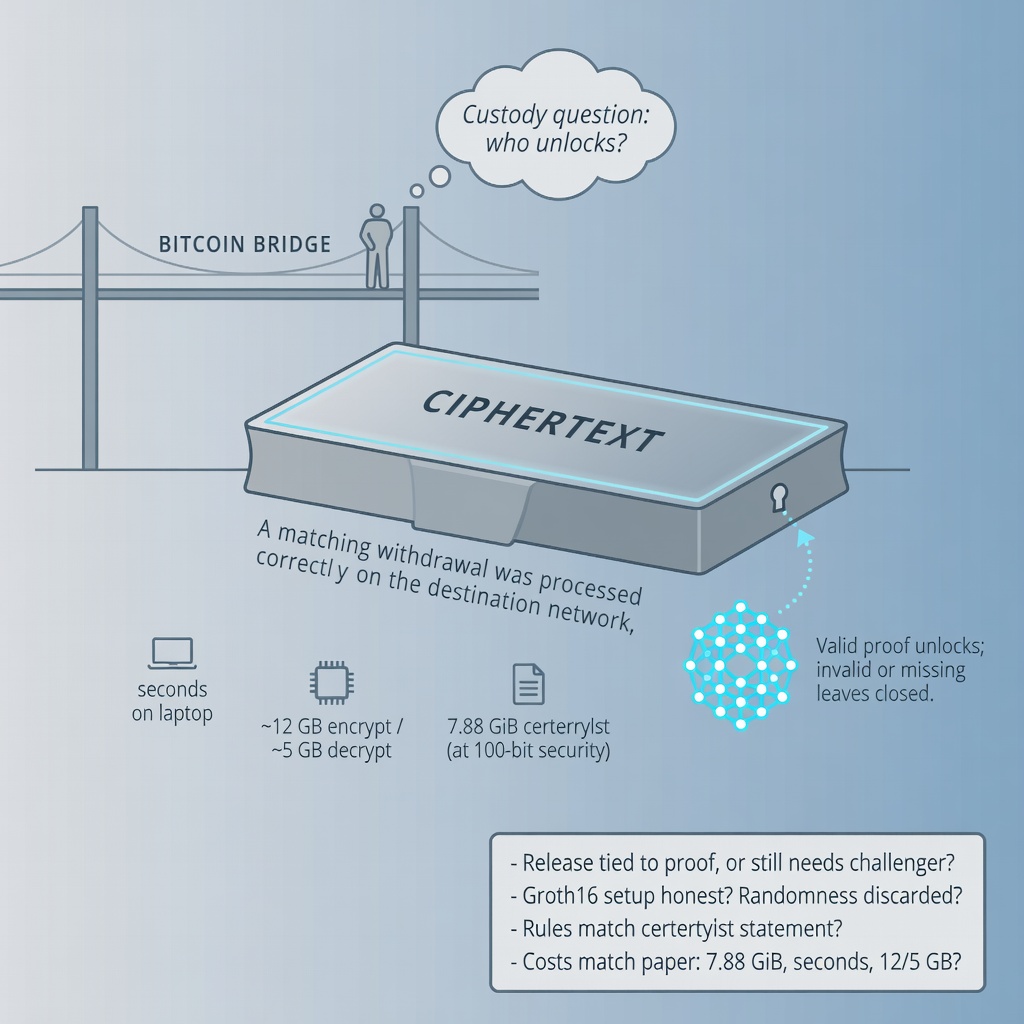
Holding bitcoin on a bridge raises a custody question before it raises a technology question: who is allowed to unlock the coins, and what fails if that party does not act. A paper from Stanford University and Byzantine Research, “Praxis: Practical Witness Encryption for NP,” describes a scheme its authors say could let some Bitcoin bridges, scaling designs, and contracts depend less on custodians and on people who must keep watching for fraud.
The researchers are David Tse, Nikhil Vanjani, and Psi Vesely. They present Praxis as a general-purpose witness encryption construction. Witness encryption, introduced in 2013, encrypts information against a mathematical statement rather than an ordinary key. Someone who can produce a valid proof that a preset condition has been met can decrypt. Someone who cannot produce that proof should not be able to.
The authors say earlier general-purpose constructions were either too costly to use or rested on assumptions that were later challenged or broken. They describe Praxis as the first construction that, under the assumptions they specify, combines general-purpose use, security arguments they treat as established, and costs they consider practical. That is a claim about a proposed construction. It is not a rule already active on Bitcoin.
A release condition instead of a key-holder
Bitcoin’s limited scripting makes it hard to check complex proofs directly on the network, especially when the computation happened on another chain. Designs such as BitVM move the computation off Bitcoin and let participants challenge a fraudulent claim with a transaction on the main network. In January, the Bitcoin zero-knowledge rollup Citrea launched its mainnet with a BitVM-based check that, as described, requires at least one honest participant to challenge fraudulent activity.
Witness encryption is offered as a different arrangement. The researchers put it this way: “A ciphertext carries its own release condition, with no key to distribute and no party trusted to release the message.”
In a bridge, the secret needed to unlock BTC on the original chain could be encrypted against a statement that a matching withdrawal was processed correctly on another network. The paper says that could reduce dependence on custodians and on people assigned to watch the bridge, but only if the protocol securely defines and enforces its withdrawal conditions. A ciphertext does not repair a badly written rule. Covenants, which restrict how coins may be spent later, are named as another possible use. Both remain potential applications, not features Praxis has switched on.
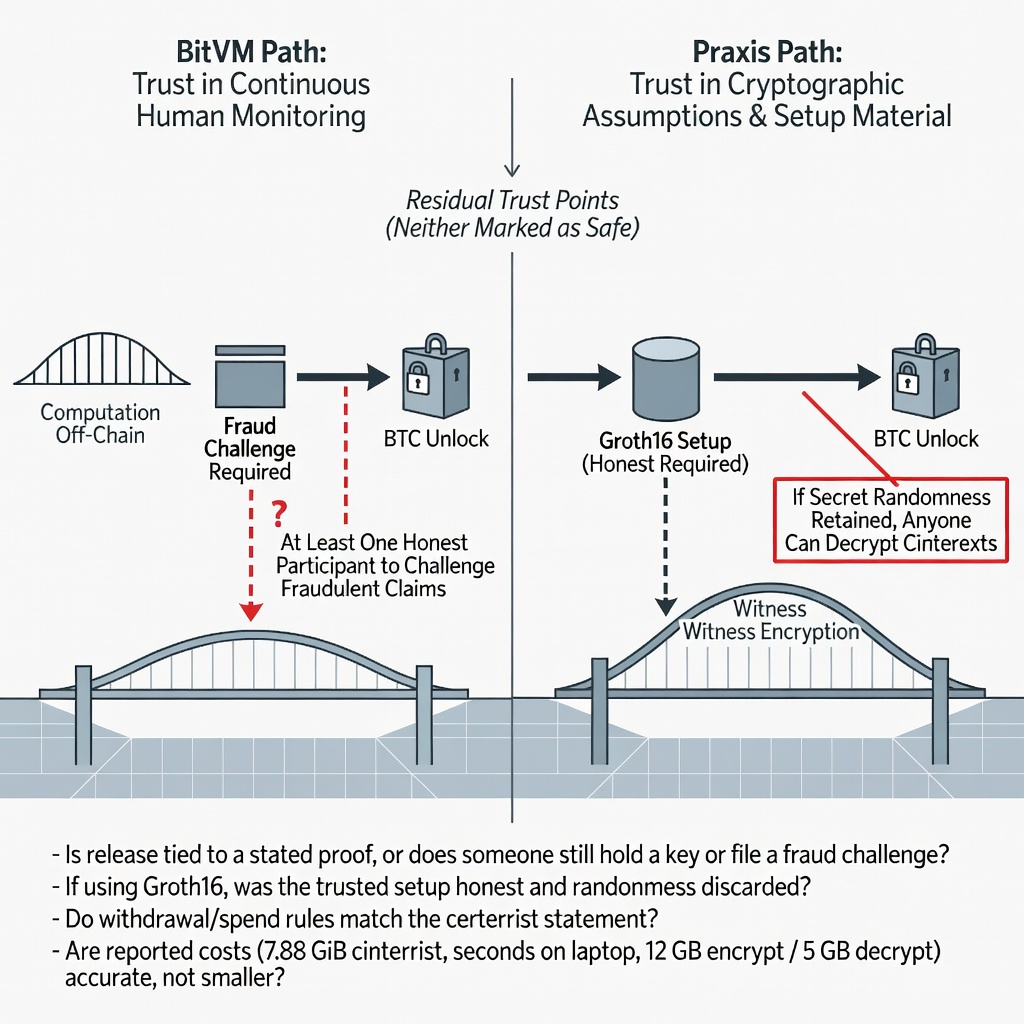
The trade-off is a change in where trust sits, not its disappearance. A BitVM-style path still needs an honest challenger. A witness-encryption path moves the release decision onto a proof and onto the assumptions behind that proof. Neither setup means the coins cannot be lost, frozen, or taken if the rules, the software, or the setup are wrong.
What gets smaller, and what trust remains
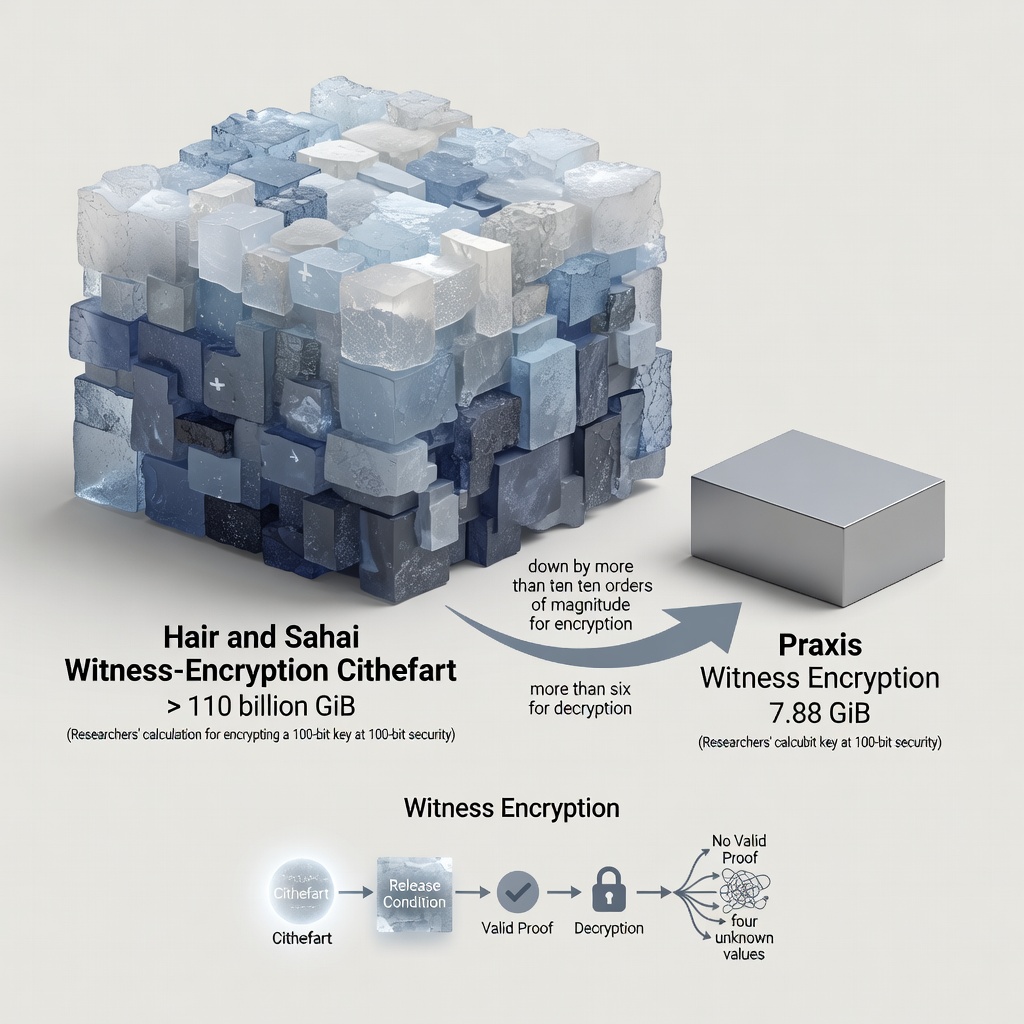
Praxis builds on earlier work by Hair and Sahai. At a 100-bit security level, the researchers calculate that the earlier construction would need more than 110 billion GiB of ciphertext to encrypt a 100-bit key under the same statement. They put Praxis at 7.88 GiB for that comparison, with ciphertext size and encryption cost down by more than ten orders of magnitude and decryption cost down by more than six.
Those figures are calculations in the paper, not measurements from a live Bitcoin system. The authors also say encryption and decryption can take seconds on a laptop, while using about 12 GB of memory to encrypt and about 5 GB to decrypt.
The scheme is meant to work with existing zero-knowledge proof frameworks. Its Groth16 version requires an honest trusted setup. Anyone who keeps that setup’s secret randomness could decrypt ciphertexts produced under the matching verification key. For a holder, that is residual trust of a familiar kind: not a custodian who chooses when to release funds, but ceremony material that must not survive the setup. Praxis does not claim to remove every trusted step.
Security is argued from Module-SIS, an assumption used in lattice-based cryptography. Unlike schemes built around one narrow problem, the authors say Praxis can take general computational statements, so the same mechanism could serve different applications without a new construction for each one. A single fixed Groth16 verification key can cover different programs. Developers could write the release condition in an ordinary language such as Rust, if a compatible proof system can check that the program produced the required result.
Praxis uses a witness key encapsulation mechanism. That produces a secret key, which then encrypts messages of any length with ordinary symmetric encryption. Someone with a valid witness has to recover one unknown value by search. Someone without a valid witness faces a much harder problem with four unknown values. That gap is the intended barrier. It is not evidence that every implementation will be free of bugs.

A separate privacy proposal is still measuring storage
Other Bitcoin work has already met the storage limits Praxis is trying to shrink. In September, researchers at Alloc Init introduced Shielded Bitcoin, a proposed system meant to conceal transaction participants and amounts without changing Bitcoin’s consensus rules. The project intends to use a witness-encryption construction called PIPEs for deposits and withdrawals.
Earlier in February, Alloc Init founder Misha Komarov said the second version of PIPEs required roughly 330 TB of ciphertext, and that researchers had identified a possible route toward about 100 GB. That is a disclosed storage figure and a possible reduction. It is not a completed cut to the 7.88 GiB Praxis figure, and Shielded Bitcoin remains a proposal. Hiding participants and amounts is a confidentiality goal; it is separate from whether a backup of keys is accessible or redundant, and this paper does not describe a backup method.
Checks that stay inside what the paper says
If a bridge, covenant, or rollup says it will use Praxis or witness encryption, a few questions follow directly from the paper. They do not make a design safe, and they are not a recommendation to move coins.
- Is release tied to a stated proof, or does someone still hold a key or have to file a fraud challenge? Citrea’s BitVM path, as described, still needs at least one honest challenger.
- If the design uses the paper’s Groth16 implementation, was the trusted setup honest, and was the secret randomness discarded? Retained randomness can decrypt ciphertexts made with that verification key.
- Do the withdrawal or later-spend rules match the statement inside the ciphertext? The bridge example reduces custodian and watcher dependence only when the protocol securely defines and enforces those conditions.
- Are the costs in view the ones the paper reports — about 7.88 GiB of ciphertext, seconds on a laptop, and roughly 12 GB to encrypt or 5 GB to decrypt — rather than a much smaller system than the research describes?
Those checks separate a reported reduction in storage, and in some kinds of continuous human monitoring, from trust that remains in cryptographic assumptions, setup material, and the rules written around the coins.